Caul Baby by Morgan Jerkins
This review was originally published by the New York Journal of Books.
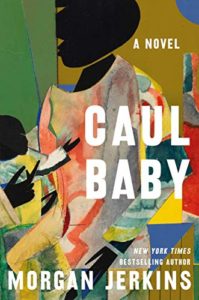 Caul Baby is an ambitious and unique novel set in a Harlem neighborhood where a powerful Creole family, the Melancons, conduct a secretive trade from their bodega storefront. They are caul-bearers, born with the birth membrane still intact. A phenomenon that occurs in about 1 in 80,000 births, caul-bearing has long been considered auspicious in many cultures.
The author evokes literary tradition and sets the mysterious tone around cauls in the opening epigraph with a quote from Charles Dickens’ David Copperfield, “I was born with a caul, which was advertised for sale. . . . The caul was won, I recollect, by an old lady with a hand-basket. . . . It is a fact which will be long remembered as remarkable down there, that she was never drowned, but died triumphantly in bed, at ninety-two.”
The Melancons sell pieces of caul as protective amulets to well-off white families. Women from outside the neighborhood are desperate for magical healing and not as disdainful of the family as their neighbors in Harlem. The Melancons, bearing a name that connotes the French for melancholy, are shrouded in rumors of magic and healing.
The price for this independence, however, is that they’ve turned their bodies, and the bodies of their offspring, into commodities.
The matriarch is Maman who brought their tradition from Louisiana to Harlem after their practices came under scrutiny there. Maman is careful to maintain isolation in Harlem and business thrives, allowing this family of women economic autonomy. The price for this independence, however, is that they’ve turned their bodies, and the bodies of their offspring, into commodities. The novel questions how far one might go to maintain self-sufficiency, to avoid the patriarchy, to bypass an altogether unwelcoming capitalist system.
The plot begins with pregnant Harlem native Laila. After having suffered multiple miscarriages, Laila seeks help from Josephine Melancon to keep her most recent pregnancy viable. But when the deal with the Melancon’s falls through, Laila’s child is stillborn. Around the same time, Laila’s college-aged niece, Amara, becomes pregnant. Amara decides to place her newborn daughter, Hallow, in a private adoption, arranged by a Wall Street trader who also moonlights as the Melancons’ agent. Unbeknownst to Amara, her daughter is born a caul-bearer and placed with the Melancons. She is raised as Josephine Melancon’s own in hopes of her carrying on the family tradition.
Mother-child relationships form an important thematic thread in this novel, from Laila’s awful loss to Hallow’s search for her mother. Each mother-child relationship portrayed in the novel suffers from fissures and misunderstanding. Josephine Melancon accuses Maman of showing Hallow off “like a pet monkey.” Maman often burns the girl’s hand in public so spectators can watch her body quickly heal itself, all in the name of marketing.
Maman reminds her daughter, “We help people. Never forget that. Everything here was maintained by us. By our bodies, so that we don’t have to answer to anyone or anything.” She explains further, “[Children] weren’t just born just to be born but to continue a lineage. We have been given a gift, Josephine, can’t you see it? The reason we’ve been able to stay here is not because there’s ample opportunity for Black women to get ahead in traditional jobs, nor is it because of a benevolent landlord, but because of this . . .” Maman says this while running her fingers along the caul of Josephine’s leg.
Caul Baby explores the female body’s various roles, what is taken from a woman, and what she chooses to give away.
Ultimately the plot leads to a point in which Amara has graduated from college and earned a law degree. She has done “everything she is supposed to get ahead.” Positioning herself for a run at District Attorney, she pursues an indictment of the Melancon family for “organ trafficking. And if the caul is traveling across state lines, that could be federal racketeering.” She is seeking justice for what happened to Laila long before and hoping for a legal win that will put her in the media spotlight. Despite doing her research, she doesn’t realize the daughter she surrendered for adoption is part of the Melancon clan.
Caul Baby explores the female body’s various roles, what is taken from a woman, and what she chooses to give away. This is most obvious with a caul, a membrane of skin, but depicted through childbirth as well. Beyond the Melancon inner circle, the novel includes practicing doulas who reveal anecdotes of difficult pregnancies and infertility in the neighborhood, adding an additional backdrop of neglect. Josephine’s sister, Iris Melancon, has a body no longer valued by the family. She is therefore relegated to the basement where she is visited by spirits. She lives “between worlds as old folks say,” inhabiting the gap between myth and reality, much like the story as a whole straddles both surrealism with its allusions to black magic and the reality of systemic racism around prenatal care that puts Black women at higher risk for miscarriage and death during childbirth.
Jerkins adeptly delivers a timely message as well as a novel replete with symbolism and metaphor. The Melancon brownstone is a character in and of itself. With jazz crooning in the background, cannabis smoke often in the air, and Iris and her spirit companions living in the basement, it is a home that moans with history and sadness.
Through Maman’s character, the novel holds a light to the trope of the Black mother…
Cracks in the walls and ceiling grow and expand over time in a ghostly scrawl. The house ultimately falls down around the women and burns to the ground. Standing in a neighborhood increasingly threatened by gentrification, the home becomes a prison to Hallow. She is sheltered and homeschooled her entire life in order to protect the caul. She needs to be on hand so that her skin may be harvested whenever customers arrive. Her innocence, confusion and despair during this most unusual girlhood presents a heartbreaking element to the story. She wonders “what [can] be called hers in this precious brownstone.” Just as her mother, Josephine, will later lament, “without Landon or Hallow or the persistent bullying from Maman. . . . she didn’t feel like a caulbearer or an ordinary. She felt incorporeal, and perhaps this dissolution was the ultimate sacrifice to this brownstone.”
Through Maman’s character, the novel holds a light to the trope of the Black mother and all she is meant to be, a church-going woman holding her family and community together. Maman is none of those things and all of those things. She is larger than life, an embodiment of contradictions alternately playing the roles of heroine, family savior, and villain. Her character is refreshing in its honesty and frankness, if not maddening in its reticence to comfort and coddle.
Caul Baby is like nothing I’ve read before. It has historical references but is overwhelmingly a book of our time. It delivers a story that weaves the nuance of Black womanhood with intergenerational struggles and triumphs and the heartache of contemporary racial injustice.

 Although this novel turns into a fast-paced thriller mid-stream, what I was drawn to was the depth with which the characters are written. Catton was especially deft at portraying a complicated female friendship between women with similar life philosophies yet extremely different personalities. In addition, the presumed villains, Lady and Lord Darvish, are painted with extreme humanity as well as the complexity that comes with a thirty year marriage. In addition, the author takes part in a good deal of social commentary, however not in a heavy handed way but through dialogue among the members of “Birnam Wood” a guerilla gardening organization that squats on unused land to grow food. There is a ton of action in this literary thriller, but for those who love to go deeper into motive and character, you will not be disappointed.