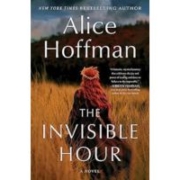
The Invisible Hour by Alice Hoffman
This review originally appeared in the New York Review of Books.
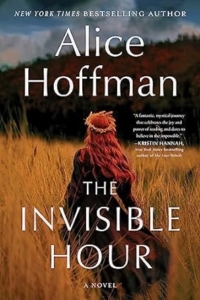 With a truly imaginative structure, Alice Hoffman delves into what has become her trademark theme of magic. The Invisible Hour asks a grand “What if?” Not so much the question posed on the book’s jacket: What if Mia Jacob never found the library or The Scarlet Letter by Nathaniel Hawthorne? The larger question the novel contemplates is whether a young woman can escape so deeply into a book, and fall so deeply in love with its author that she time travels to 1837 to be with him? And what if their meeting and ensuing mutual love is what propelled him to write that very masterpiece, ultimately dedicating it to her?
Indeed, when Mia Jacobs breaks the rules of “The Community,” the cult-like farm setting in which she lived with her mother and was raised from birth to discover the small library in the town of Blackwell along with its kind librarian, a new world opens up to her. When she turns the cover of a first edition of The Scarlet Letter and reads its dedication, “To Mia, If it was a dream, it was ours alone and you were mine,” her imagination is set free. She wonders whether this book was truly meant as a message to her.
When Mia’s mother Ivy Jacob was a teenager in Boston, she found herself pregnant and ostracized by her Beacon Hill family. She fled to a farm in western Massachusetts overseen by Joel Davis who took care of her and protected her in a way her family never did. However, “The Community” had rigid rules where children were taken away from their mothers to be raised communally, where books or interaction with the outside world was forbidden, and where Joel Davis’s word was final. He took Ivy for a wife and treated her as his favorite, which led to some leniency when it came to Ivy and Mia’s behavior. However, when books were uncovered in haybales in the barn, somebody had to be punished. In order to protect her daughter, Ivy claimed they were hers and as a result, her beautiful long red hair was cut off.
Despite Mia trying to convince her mother that they should run away, Ivy feared Joel would find them and cause them harm. Indeed, he proved adept at seeking out Mia after her successful escape from The Community. During her low point, after her mother’s death, when Mia felt she has nothing left to lose, she made her way to the Blackwell Library in the dark of night, used a key the librarian had snuck her and asked for help.
Sarah, the librarian, was able to create a refuge for Mia across the state in Concord where she could begin a more normal life, attending school and spending time in the library. Joel was often spotted lurking nearby. He let her know he was watching by leaving the unmistakable red leaves of The Community’s signature apples, or by confronting her guardian Constance. After graduating from college, Mia finds her dream job working at the New York Public Library.
The second half of the novel is set in the 1837 in Salem, MA where Nathaniel Hawthorne is a depressed young man, living with his mother and sisters. He feels a failure as a writer and guilt over his grandfather’s role persecuting women as part of the Salem witch trials. Mia’s copy of The Scarlet Letter is a key to time travel and she soon finds herself in Salem as well, spending time with Nathaniel in a secret cottage in the woods and buoying him with her love.
Not wanting to alter the course of history and because of Nathaniel’s sister Elizabeth’s reproachful warnings, Mia returns to the present. She has no choice to return to 1837, however, after Joel hunts her down, claiming she has stolen the deed to his farm. He is relentless in his pursuit and so Mia returns to the past, dragging Joel along with her. It is during this period that Mia realizes she is pregnant with Nathaniel’s child. She will return to the present where she will raise her daughter proudly as a single mother.
Unwed motherhood and the ostracization that comes with it is a constant backdrop, allowing Hoffman to connect the branding of Hester Prynne with the experiences of Ivy and later Mia. Nathaniel’s sister, Elizabeth, introduces Mia to a hill dubbed the Hill of Death by some, Salvation Point by others, a place where women went to eat herbs in order to bring about miscarriage. Mia tells her of a later time when women have many opportunities including higher education and professional, while still not having autonomy when it came to reproduction. Mia’s time travel highlights the many differences between the past and the present, however, with regard to women’s autonomy, Hoffman drives home the point that frightingly little has changed.

About The Invisible Hour:
One June day when Mia Jacob can no longer see a way to survive, the power of words saves her. The Scarlet Letter was written almost two hundred years earlier, but it seems to tell the story of Mia’s mother, Ivy, and their life inside the Community–an oppressive cult in western Massachusetts where contact with the outside world is forbidden. But how could this be? How could Nathaniel Hawthorne have so perfectly captured the pain and loss that Mia carries inside her?
Through a journey of heartbreak, love, and time, Mia must abandon the rules she was raised with at the Community. As she does, she realizes that reading can transport you to other worlds or bring them to you, and that readers and writers affect one another in mysterious ways. She learns that time is more fluid than she can imagine, and that love is stronger than any chains that bind you.
As a girl Mia fell in love with a book. Now as a young woman she falls in love with a brilliant writer as she makes her way back in time. But what if Nathaniel Hawthorne never wrote The Scarlet Letter? And what if Mia Jacob never found it on the day she planned to die?
From “the reigning queen of magical realism” (Kristin Hannah, New York Times bestselling author), this is the story of one woman’s dream. For a little while it came true.
Read more of Jeannie’s Reviews on her blog, on Goodreads or StoryGraph, or on the New York Journal of Books. For more TBR inspiration, check out Jeannie’s curated book lists at Bookshop.org.







 A great read which will inspire you to get out of the chair. Bohr does an excellent job of honestly telling recounting the ups and downs of completing one of the world’s iconic hikes with her husband Joe, both in their 60’s. A reminder that one is never too old to take on a challenge, whether physical or otherwise, I loved reading this book and felt like the author was giving all of us a gentle nudge to get going!!
 After learning this work shared the Pulitzer Prize in Fiction with Demon Copperhead, I had to read. I listened to the Audio which was narrated by four different voices, amplifying this novel’s theme of perception. Indeed a story changes so much based on who is telling it and Diaz makes this clear with regard to a marriage, mental health, wealth, and power. Who’s version do you trust? This novel is entertaining but important in that it provokes introspection around narration and point of view, reliability and inherent bias. Highly recommend.