Sunday Money by Maggie Hill
Sunday Money by Maggie Hill
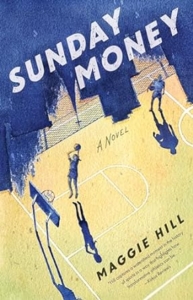

About Sunday Money:
It’s 1971, but for Claire Joyce and girls’ basketball, it might as well be 1871. Stilted rules (three-bounce dribbling, two roving players for full-court games, and uniforms that include bloomers) set their play unfairly apart from the boys’ basketball Claire’s older brother John has trained her in.
Basketball is the only constant in Claire life, and as she enters her teen years the skills she’s cultivated on the court—passing, shooting, and faking—help her guard against the chaos of an alcoholic mother, an increasingly violent younger brother, and the downward spiral her beloved John soon finds himself unable to climb out of. Deeply cut from the cloth of the Catholic Church, Brooklyn’s working class, and the limited expectations her world has for girls, Claire strives to find a mirror that might reflect a different, future self. Then Title IX bounces on the scene. Suddenly, girls’ basketball becomes explosive, musical, passionate, and driven—and if Claire plays it just right, it just might offer a full ride to a previously out-of-reach college.
Sunday Money follows Claire as she narrates her way through 1970s Brooklyn, hustling on and off the court and striving to break free of the turmoil in her home and the rulebook “good” girls are supposed to follow.
Read more of Jeannie’s Reviews on her blog, on Goodreads or StoryGraph, or on the New York Journal of Books. For more TBR inspiration, check out Jeannie’s curated book lists at Bookshop.org.
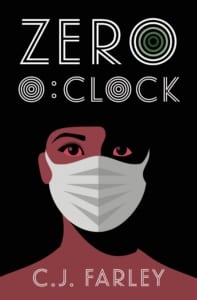 In the first line of CJ Farley’s latest novel, Zero O’Clock, Geth Montego says she “would give anything to make old people remember what it’s like to be a teenager.” To that, I say “mission accomplished.” Not only did she take me back to that vulnerable time, Geth illuminated the unique challenges of high school graduating seniors in the class of 2020. Zero O’Clock is a beautiful and timely YA novel that is both heartbreaking and whip smart, a glimpse into the world of virtual friendship, classrooms, and pop stardom. Most importantly, this novel is a rallying cry, a writer’s attempt to galvanize a global and national crisis. Through Geth’s eyes, Farley’s narrative raises issues of societal inequities and racial injustice through the voices of authentic characters who display courage and resolve. I would encourage readers of any age to take Geth’s hand as she navigates unimaginable loss and to emulate her examples of grace. “Even when we have nothing, we have something to give.”


