Writing Daughter of a Promise, a Biblical Retelling
This essay was originally published on Women Writers, Women’s Books.
Some people assume writing a third novel must be easier than writing the first, which is true to some degree only because one knows what to expect: that they are in for a long, winding, doubt-ridden journey. When I began drafting Daughter of a Promise I wasn’t sure what the challenges would be, only confident there would be plenty.
It was the winter of 2020, and I was promoting The Nine and working on this new novel, when COVID hit. I began writing with more rigor, mostly to preserve my sanity. My thinking at the time was if I was going to be stuck in this house with my husband and grown children, it would be nice if something came of it.
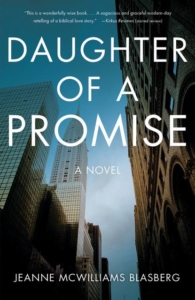 It’s probably not a surprise that the plot of Daughter of a Promise collides with COVID, just as I was experiencing the same. The final drafts of the manuscript contained about thirty-thousand words too many and as I poured over the third act looking for sections to cut, I was confronted with the vivid details of those early pandemic days, almost as if I’d included a domestic journal. Although much of that was eliminated, the novel brings back memories of the desperation we were all feeling at the time.
After completing a first draft during the winter of 2021, I applied and was accepted to the Southampton Writers Conference BookEnds fellowship where a dozen writers take a year to revise, rewrite, and polish their work. We were assigned to pods of three where, for six months, we workshopped each other’s revisions, keeping in mind the general prescription from the faculty for each book’s re-write. The process of giving and receiving feedback from two other writers with whom I shared synchronistic themes and sensibilities was wonderful.
The feedback I received in our initial meeting was twofold: 1) the story, as I had written it, was being revealed in the wrong order and 2) successful retellings tend to use a “light touch.” You see, just as with my first two novels, Daughter of a Promise is a modern retelling, this time of the tale of David and Bathsheba from the Book of Samuel in the Hebrew Bible.
During the second half of the year, I was assigned a BookEnds mentor, a successful author with whom I worked exclusively. My mentor was Scott Chesire, author of As High as the Horses’ Bridles which is also full of biblical retelling references. Our mission was to figure out the “why” of my novel and how it should begin.
“Why” was it imperative that my (first person) protagonist, Betsabé, tell this story at this particular point in time. Instead of addressing my pages specifically, Scott had me read the first chapters of dozens of works that were written in the first person and in our weekly phone calls we discussed them as well as my admiration of slightly unreliable narrators. Not that Betsabé turned out remarkably unreliable, but she justified past decisions and questioned her memory.
I redrafted my biblical retelling as a letter from Betsabé to her unborn son, Sol. She writes in the retrospective to the second child she conceives with David. In the bible, Solomon carries the mantle of wisdom with the implication being he received this wisdom from GOD, whereas my novel makes the case his wisdom was passed down from his mother.
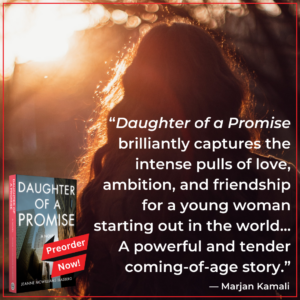 Betsabé writes of a tumultuous year, graduating from college, starting a job on Wall Street, and falling in love with her powerful boss. While the onset of the COVID would provide convenient subterfuge for her affair with David, it would also usher in the undoing of so much more. Ultimately Betsabé is broken open and forced to trust her own innate wisdom and the teachings of her family.
People often ask why I like to cast stories from the bible in contemporary settings. I hope to illustrate how biblical narratives speak timeless truths of the human condition. A powerful king, a young beauty …. from my first reading, I viewed the tale of David and Bathsheba as entirely modern. For centuries the rabbis have debated whether the couple came together in a consensual manner. Whether they did or they didn’t, the bible’s telling is relative to David’s life. Bathsheba’s feelings are not addressed at all.
I needed to write Daughter of a Promise to give her a voice. My Betsabé is a strong young woman trying to find her place in the world, trying to balance the teachings of her family back home in Miami with all she is learning during her analyst training program at the bank.
She trying out versions of feminism that feel right to her, and she is falling in love. She is falling in love with a city, with a best friend in her roommate, and with a powerful, handsome man. Yes, she makes some questionable decisions but ultimately becoming aware of why one made those choices breeds wisdom.
—
Jeanne Blasberg is an award-winning and bestselling author and essayist. Her novel The Nine (SWP 2019) was honored with the 2019 Foreword Indies Gold Award in Thriller & Suspense and the Gold Medal and Juror’s Choice in the 2019 National Indie Excellence Awards. Eden (SWP 2017), her debut, won the Benjamin Franklin Silver Award for Best New Voice in Fiction and was a finalist for the Sarton Women’s Book Award for Historical Fiction. Her forthcoming novel, Daughter of a Promise (SWP, April 2, 2024) is a modern retelling of the legend of David and Bathsheba, completing the thematic trilogy she began with Eden and The Nine.
Jeanne cochairs the board of the Boston Book Festival and serves on the Executive Committee of GrubStreet, one of the country’s preeminent creative writing centers. Jeanne was named a Southampton Writer’s Conference BookEnds Fellow in April 2021. She reviews contemporary fiction for the New York Journal of Books, When not in New England, she splits her time between Park City, UT, and growing organic vegetables in Verona, Wisconsin.
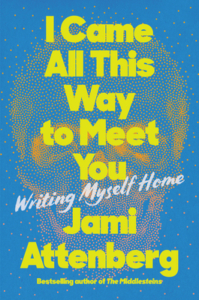 This an especially good read for a writer. It is an inspiring story of perseverance from an author I admire. The opportunity to glimpse into her life and professional ups and downs was a treat. I have participated in Jami’s
 My Dark Vanessa by Kate Elizabeth Russell
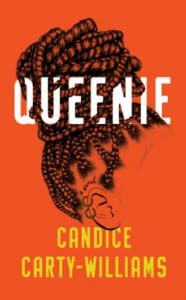 Queenie by Candice Carty-Williams


 This summer, in an effort to focus just as much on the generative side of my nature as I knew I would on the promotional side (remembering my experience with my debut novel,
  I’m sure many authors read the above like it’s obvious – of course you keep up a writing practice come hell or high water. That’s what you do. But I bet there are others reading this who like the reminder, indie authors like me who manage much of their own promotion, schedule their own book appearances, and do a ton of footwork – authors like me who are relatively new to this and might lose sleep wondering if there is something else that should be done to give a book the best chance at being noticed. I don’t want to live the next several months with that chatter in my head and the consequential lack of focus.
 On our recent
 The Ritual of Writing
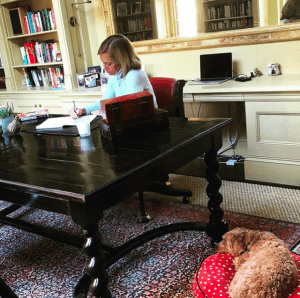
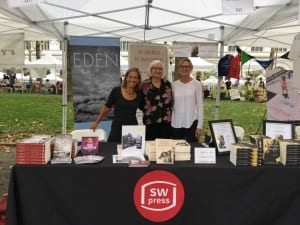
 I accept invitations and view every opportunity to discuss my book as a blessing. I have fully immersed myself in the literary community in Boston. I attend readings. I take classes. I am workshopped, and I accept feedback. I blog and submit essays for publication. If I am writing I tell other people not to bother me. My business cards read “author.” I attend conferences. I approach people. I watch what the authors I admire do and I try to emulate them. When I am not writing, I am reading. I review books.
 Reject those who are rejecting you.
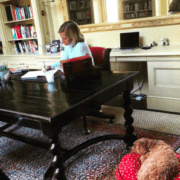
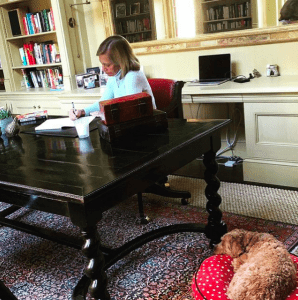 I took a “Writing from Personal Experience” class in Cambridge taught by Mopsy Strange Kennedy. An exercise she often assigned us involved going on “writerly walks.” She encouraged us to travel our usual paths but make the effort to really notice – maybe for the first time – the details along the route: the bicycle chained to a post, the balustrade in need of paint, the torn screen on a window. After the walk, we were supposed to write about a particular object, the more mundane the better, but the purpose was to infuse that object with meaning. It was a good way to develop writing muscle as well as the art of paying attention. I noticed quirks and color and inconsistencies. I noticed the way the sun reflects off a window or the way steam rises off hot pavement, windows that were open wide and music that traveled to the sidewalk, even the scent of hot pizza escaping a delivery bike’s insulated red container. I noticed trash and dog poop, as well as crocuses pushing up through the earth.


