Where were you four years ago? COVID in the rearview (and the writing)

Four years ago this month, our nation shut down with the onset of the COVID pandemic. Thinking back on those days still elicits painful memories of confusion, disruption, and terrible loss. We each have unique stories of how COVID impacted our lives. The first half of 2020 irreversibly changed my outlook. I became fixated on our world’s fragility and brokenness, feelings that led to selling our family home in Boston and investing in farmland among other things.

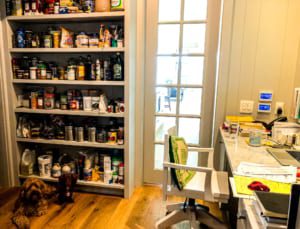
jeanne-blasberg-office-covid-quarantine-dogs-pantry

My desk in the pantry, guarding the food and close to the coffeemaker. Also, Brady and Churro kept me company (furry friends bottom left).

But mid-March of 2020, before those personal shifts were set in motion, I was hunkering down in our pantry while the rest of my family staked claim to more private workstations, and threw myself into drafting the manuscript that would eventually become Daughter of a Promise.

It was inevitable that the storyline would coincide with COVID. How could it not? One early draft practically read like a diary of domestic insanity including tracking down n-95 masks, washing off groceries, and wearing rubber gloves to get the mail. I knew of authors whose manuscripts were drafted or were in the publishing queue during big world or political events, leading to the question of how to address them. When I equivocated, an author friend reminded me:

“It’s our job to document the blood in the streets.”

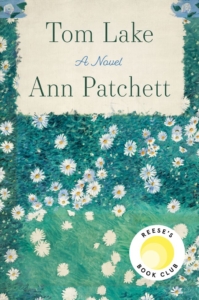
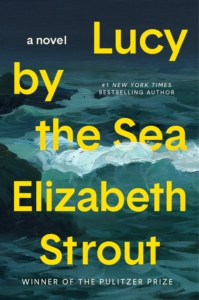
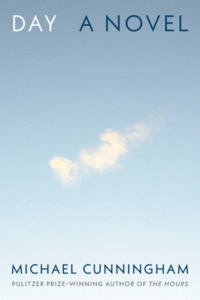
Several in the publishing industry warned against it, saying readers would not have an appetite for revisiting those years. Nevertheless, I sensed COVID would play a major role in my novel from the onset. Stories exist, after all, to help us make sense of what’s happened. Perhaps returning to those days in a character’s shoes makes it easier to process. What do you think? Given that three of my favorite novelists recently came out with books incorporating COVID puts me in good company:

tom-lake-ann-patchett-covid-novel   lucy-by-the-sea-elizabeth-strout-covid-novel   day-michael-cunningham-covid-novel

Daughter of a Promise will pub in less than two weeks!! I’m dropping teaser videos like the one above on #trailertuesday, follow my Instagram to not miss any!

full schedule of live events is on my website, but my first three stops will be:


I WOULD LOVE TO SEE YOU!!

Writing Daughter of a Promise, a Biblical Retelling

This essay was originally published on Women Writers, Women’s Books.

Some people assume writing a third novel must be easier than writing the first, which is true to some degree only because one knows what to expect: that they are in for a long, winding, doubt-ridden journey. When I began drafting Daughter of a Promise I wasn’t sure what the challenges would be, only confident there would be plenty.

It was the winter of 2020, and I was promoting The Nine and working on this new novel, when COVID hit. I began writing with more rigor, mostly to preserve my sanity.  My thinking at the time was if I was going to be stuck in this house with my husband and grown children, it would be nice if something came of it.
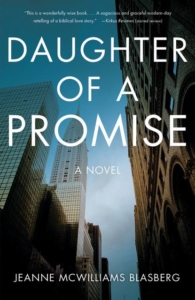
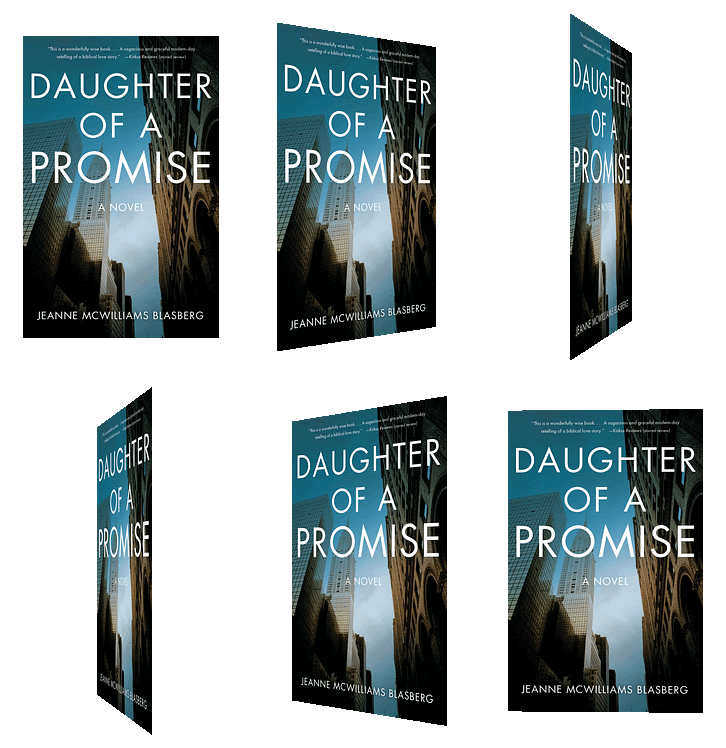
Daughter of a Promise Book Cover, a biblical retellingIt’s probably not a surprise that the plot of Daughter of a Promise collides with COVID, just as I was experiencing the same. The final drafts of the manuscript contained about thirty-thousand words too many and as I poured over the third act looking for sections to cut, I was confronted with the vivid details of those early pandemic days, almost as if I’d included a domestic journal. Although much of that was eliminated, the novel brings back memories of the desperation we were all feeling at the time.

After completing a first draft during the winter of 2021, I applied and was accepted to the Southampton Writers Conference BookEnds fellowship where a dozen writers take a year to revise, rewrite, and polish their work. We were assigned to pods of three where, for six months, we workshopped each other’s revisions, keeping in mind the general prescription from the faculty for each book’s re-write. The process of giving and receiving feedback from two other writers with whom I shared synchronistic themes and sensibilities was wonderful.

The feedback I received in our initial meeting was twofold: 1) the story, as I had written it, was being revealed in the wrong order and 2) successful retellings tend to use a “light touch.”  You see, just as with my first two novels, Daughter of a Promise is a modern retelling, this time of the tale of David and Bathsheba from the Book of Samuel in the Hebrew Bible.

During the second half of the year, I was assigned a BookEnds mentor, a successful author with whom I worked exclusively.  My mentor was Scott Chesire, author of As High as the Horses’ Bridles which is also full of biblical retelling references. Our mission was to figure out the “why” of my novel and how it should begin. 

“Why” was it imperative that my (first person) protagonist, Betsabé, tell this story at this particular point in time. Instead of addressing my pages specifically, Scott had me read the first chapters of dozens of works that were written in the first person and in our weekly phone calls we discussed them as well as my admiration of slightly unreliable narrators. Not that Betsabé turned out remarkably unreliable, but she justified past decisions and questioned her memory.

I redrafted my biblical retelling as a letter from Betsabé to her unborn son, Sol. She writes in the retrospective to the second child she conceives with David.  In the bible, Solomon carries the mantle of wisdom with the implication being he received this wisdom from GOD, whereas my novel makes the case his wisdom was passed down from his mother.
Daughter of a Promise, by Jeanne Blasberg, a powerful and tender coming of age wBetsabé writes of a tumultuous year, graduating from college, starting a job on Wall Street, and falling in love with her powerful boss. While the onset of the COVID would provide convenient subterfuge for her affair with David, it would also usher in the undoing of so much more.  Ultimately Betsabé is broken open and forced to trust her own innate wisdom and the teachings of her family.

People often ask why I like to cast stories from the bible in contemporary settings. I hope to illustrate how biblical narratives speak timeless truths of the human condition. A powerful king, a young beauty …. from my first reading, I viewed the tale of David and Bathsheba as entirely modern. For centuries the rabbis have debated whether the couple came together in a consensual manner. Whether they did or they didn’t, the bible’s telling is relative to David’s life. Bathsheba’s feelings are not addressed at all.

I needed to write Daughter of a Promise to give her a voice. My Betsabé is a strong young woman trying to find her place in the world, trying to balance the teachings of her family back home in Miami with all she is learning during her analyst training program at the bank. 

She trying out versions of feminism that feel right to her, and she is falling in love. She is falling in love with a city, with a best friend in her roommate, and with a powerful, handsome man. Yes, she makes some questionable decisions but ultimately becoming aware of why one made those choices breeds wisdom.

Jeanne Blasberg is an award-winning and bestselling author and essayist. Her novel The Nine (SWP 2019) was honored with the 2019 Foreword Indies Gold Award in Thriller & Suspense and the Gold Medal and Juror’s Choice in the 2019 National Indie Excellence Awards. Eden (SWP 2017), her debut, won the Benjamin Franklin Silver Award for Best New Voice in Fiction and was a finalist for the Sarton Women’s Book Award for Historical Fiction. Her forthcoming novel, Daughter of a Promise (SWP, April 2, 2024) is a modern retelling of the legend of David and Bathsheba, completing the thematic trilogy she began with Eden and The Nine.

Jeanne cochairs the board of the Boston Book Festival and serves on the Executive Committee of GrubStreet, one of the country’s preeminent creative writing centers. Jeanne was named a Southampton Writer’s Conference BookEnds Fellow in April 2021. She reviews contemporary fiction for the New York Journal of Books, When not in New England, she splits her time between Park City, UT, and growing organic vegetables in Verona, Wisconsin.
Slowing it Down: Talking Snow, Story, and Swirling Change

Greetings from Park City where the world outside my window swirls with snow and the world inside my head swirls with story—from all that I saw at The Sundance Film Festival, as well as daily reading and writing. This includes re-reading Great Expectations by Charles Dickens and Middlemarch by George Elliot with FrizzLit. I highly recommend his book clubs!

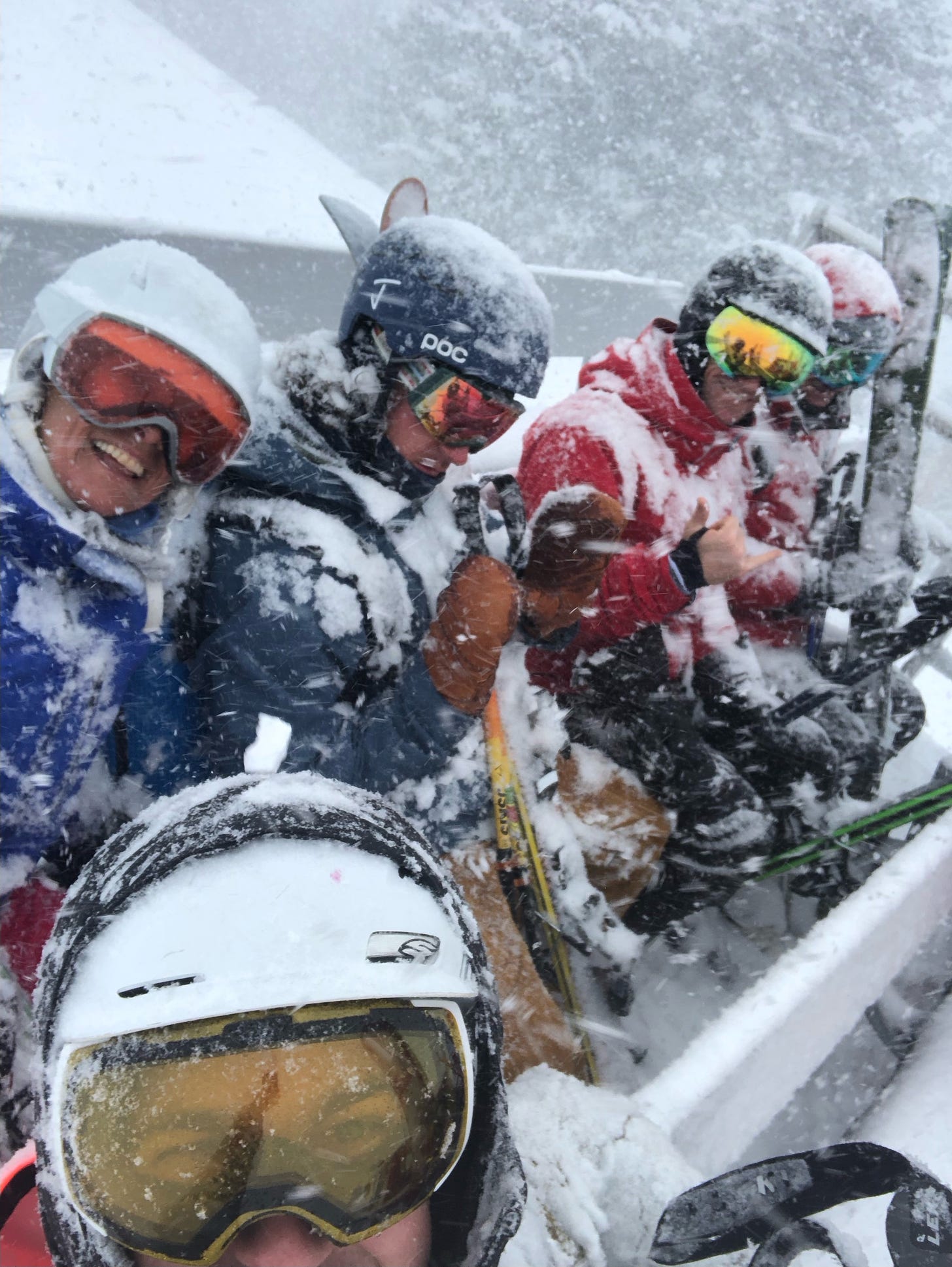
A snowy President’s Day Weekend, skiing with my sons and friends in UT.

I’m also busy preparing for the publication of Daughter of a Promise on April 2, completing interviews, writing articles, scheduling live events, as well as recording podcasts. If you haven’t yet preordered, please consider doing so! Let me know when you do and I’ll send you the e-reader version of my debut novel, Eden, as a thank you!

I am very proud of the protagonist in this book. Never has one of my characters undergone as much transformation as Bets Ruiz. She begins young and idealistic, a recent college graduate on the threshold of adulthood. She’s at that stage in life where she’s filled with hope and anxiety in equal measure. The novel is told from her retrospective point of view, in the form of a letter to her unborn son, about one fateful year. It is a year filled with desire, love, and tragedy – a year that breaks her open and ushers her into womanhood.

I’ve heard people call personal transformation reinvention – as if we always have a choice! I recently read an excerpt from Alain de Botton’s new book in Oldster Magazine that got me thinking about the change we choose to initiate. The author encourages people to not measure their lives in years but instead by the richness of those years. His theory hinges on a view that time exists in our minds, expanding or contracting based on how engaged we are in the present moment. When absorbed in something new, time is expansive. Being in a rut or stuck in a predictable routine, however, gives the effect of weeks, years, and decades passing by quickly. Initiating change may seem like a luxury not everyone is prepared to take on. However, it’s interesting to consider what holds us back. 

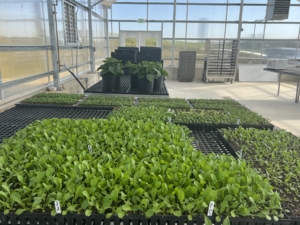
flynn-creek-farm-planting-season-greenhouse-rows

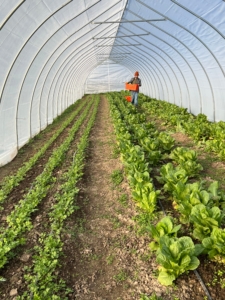
Extending the growing season in the upper Midwest

One thing that holds us back is fear. Deciding to dedicate myself to Flynn Creek Farm required I overcome fear. And it still does! Farming is incredible during the growing season surrounded by green land, with time expanding as broadly as the big blue sky. In the middle of the night, however, when Wisconsin is dark and covered in snow, I confess to waking in a panic.

Nonetheless, embracing change and tackling fear seem to be integral on my journey. I love skiing because of the opportunity to bite off chunks of fear. Publishing a novel, moving to a new town, and taking on a big project have all kept me awake at night with different degrees of doubt, but they have also resulted in immense joy and satisfaction. They have slowed time. Letting go of the past to make room for new things is my way of affirming life, my acknowledgment that there are many possible paths in this world and I needn’t settle for only one.

Constantly_curating_jeanne_blasberg_substackI’d love to hear about your experiences or philosophy of adopting change. Leave a comment below or on my Substack!


New Year, New Writing Updates!

The essay “New Year, New Writing Updates!” originally appeared on Jeannie’s Substack, Constantly Curating. Subscribe here for monthly updates!

Happy New Year!

If you’re a long-time reader or you’ve subscribed to my newsletter in the past, you may have noticed I’ve migrated my essays and letters to Substack. Introducing…

Logo for Jeanne Blasberg's Substack newsletter, Constantly Curating, in white text with black shadow on a bright red background with a white border

I hope to share writing monthly, and I hope you’ll come along with me on the journey. If you haven’t yet, please subscribe to my newsletter there to keep in touch! I’m excited to share lots of fun things with you this spring like upcoming events and book giveaways (hint hint, keep reading)—and let’s not forget the most exciting news of all:

My new novel, Daughter of a Promisewill be released on April 2nd. I am very proud of this book and I am grateful for the positive feedback to date. Kirkus gave it a starred review, calling it, “A sagacious and graceful modern-day retelling of a biblical love story,” and Foreword called it, “….a powerful feminist novel set during a tumultuous year in New York.”

Daughter of a Promise Book CoverAnd yes, it’s a love story! A retelling of the legend of David and Bathsheba. My protagonist’s journey of love, loss, and self-awareness is one, I hope, many readers will relate to. Fans of Eden and The Nine, will enjoy the reappearance of some familiar characters and revisiting a beloved Rhode Island beach town.

If you preorder Daughter of a Promise, and forward me a screenshot or photo of the receipt, I’ll send you an ebook download of Eden as a thank you! Preorders boost book-selling algorithms and help more people find the book, so I would truly appreciate your support.


This is a wonderfully wise book. Blasberg is an accomplished writer, and in Betsabé Ruiz she has created an insightful and strong young woman. “ — Kirkus Reviews (starred review)


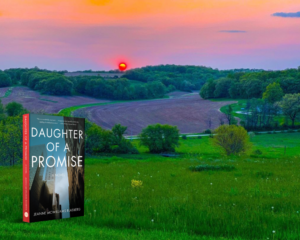
flynn-creek-farm-sunset-jeanne-blasberg-daughter-of-a-promiseIn other news … John and I have bundled our passions for food, wellness, and the environment into a new venture called Flynn Creek Farm. It’s a 420-acre farm southwest of Madison, WI where we are growing veggies for the Forage Kitchens fast-casual restaurant chain. The master plan for the farm involves returning organic matter to the topsoil to grow small grains and graze cattle. We have dreams of planting an orchard and becoming a destination for education and eco-tourism. Building the wonderful team at Flynn Creek has brought both of us much joy as well as humility and new learning. I will always write fiction, but don’t be surprised if my content is inspired by this new adventure!
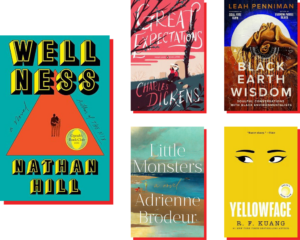
book-recommendations-wellness-great-expectations-yellowface-little-monsters-black-earth-wisdomThat’s all my exciting news for the moment, but stay tuned for updates. In the meanwhile, let me leave you with some books I’ve read this winter and highly recommend:
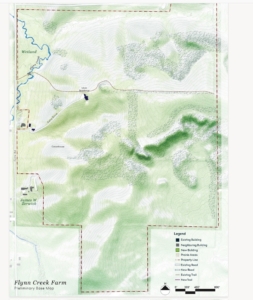
Check them out! And let me know what you’ve been reading.

Wouldn’t We All Love a Master Plan?

People ask what happens on the farm during the winter. The answer is a lot: planning, budgeting, and purchasing new equipment. Since Flynn Creek Farm is still so new to us, our planning is on two levels.  The first is for the short term – what are we going to do next season? We are also in the process of imagining a decade-long Master Plan. Although such an undertaking feels like we are giving GOD a good reason to laugh while our faces hover over a map, stewarding 420 acres is a great responsibility and every change to the land we consider has many ripple effects and so to move forward with a single initiative, we must understand its effect on the whole.

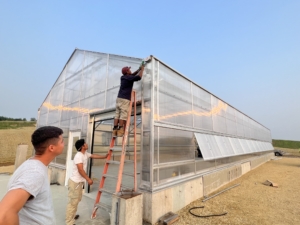
For example, we built a greenhouse for transplants last summer. Its location is adjacent to existing produce fields but also determines the location of future produce fields. Those fields need irrigation, thus impacting the location of wells.  Drilling one important well came with several challenges and we had to come up with a second-choice location. We chose a spot that would serve future infrastructure. Thus, the well location has determined the siting of a future wash/pack facility and livestock operation.

Our land has many hills and valleys and using gravity to direct water flow and natural irrigation is something we need to be intentional about.  Knowing we may have more drought years like we just experienced, moving earth to create water retention ponds is important. But one large pond or several small ones?

We hope to plant an orchard on a south-sloping hillside and introduce more livestock.  Both of these initiatives require substantial perimeter as well as interior fencing.  Fencing is expensive, so the consideration as to where a perimeter fence goes is important both financially, as well as in terms of not wanting to chop up the farm too much.

This takes me to one of the most fundamental aspects of our planning, and movement – pathways, farm roads, and trails for both vehicles and on foot.  Deciding the appropriate ingress and egress for commercial vehicles, for employees (read parking), as well as for visitors including future event attendees is one of the first things we had to consider.  It’s also one of those things you can’t determine until you work and travel the land for at least a year.  We are just entering a phase in which we can have a point of view.

So, we plan, keeping in mind what our consultant calls “degrees of permanence.”  In my non-farming life, I refer to one-door or two-door decisions –all boiling down to whether or not you can take something back.  Because in farming as well as in most small businesses, you need to leave room for experimentation, for failure, and for trying over.  One of our business principles is to prototype early and often… not just with the crops we grow, but in terms of how we use the land and where we create enterprises on the land.

The experimental mindset means planting a few trees before a full orchard. Before you begin selling organic compost commercially, you need to experiment on your own farm.  Before you bring in a herd of cattle, why not see how you do with a season’s worth of goats or sheep….  There is a tension between wanting a Master Plan and also wanting to be a laboratory, between feeling extreme urgency and not making permanent decisions too quickly.  So many metaphors that the writer in me wants to grasp onto, but basically farming presents a keen ability to think things through.  A great life lesson all around.

The Dis-ease

The essay “The Dis-ease” previously appeared on Jeannie’s Substack. Subscribe here for monthly updates!

Many years back my doctor prescribed genetic screening because of a history of cancer in my family.  A finding that had been inconclusive seven years ago was now raising some concern and so I recently returned to Dana Farber Cancer Center in Boston to have blood drawn for an additional screening. As I sat in the waiting room with dozens of patients undergoing cancer treatments, I couldn’t help but count my blessings.

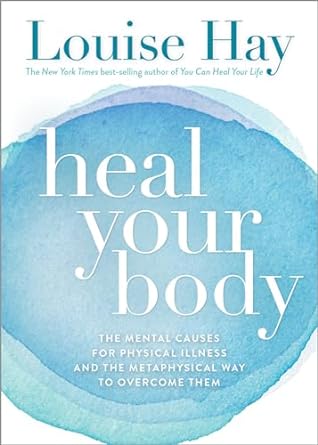
heal-your-body-book-louise-hay-dis-easeLater, out on the sidewalk, surrounded by scores of pedestrians, I couldn’t help contemplating these fragile vessels that carry us through life. Our bodies. We come in all shapes and sizes, yet signs of a healthful state and symptoms of “dis-ease”  are manifest. Whether it’s weight loss or weight gain, thin hair, or an ashy complexion, our outward appearances can reflect whatever pain or ailment we are carrying inside. And it doesn’t need to be as serious as cancer. In HEAL YOUR BODY by Louise Hay, she ties all physical ailments, every state of dis-ease, to some emotional wound.
There’s also the fact that our environments, over much of which we have no control, impact our well-being. The quality of our air, our water, noise pollution, even our access to nutritious food are often out of our control, dictated by our neighborhoods, our parents, and socio-economic factors in general. From the moment we take our first breath, we are vulnerable to the state of our environment. It had always been my ideal that the powers that be were looking out for us. I was raised to believe I lived in the greatest country on earth, and yet….  And yet life expectancy in the United States has been in decline and ranks 47th among countries across the globe.

Digging into one factor, such as the food system, feels like I’ve uncovered a betrayal. True: Post WWII farming techniques and mass food production provided unprecedented calories for a growing population, but at what cost?  Feels like the bill is coming due. I don’t want to point the finger at big corporations alone, because the consumer should also take some blame. So many of us are city dwellers who have become increasingly detached and disinterested in where our food comes from.  As Americans we have been conditioned to value price and convenience over the quality.

We have raised a generation of young people whose answer to where their food comes from is, “the grocery store.”  In addition to not appreciating one’s local, seasonal food harvests, people are making increasingly unhealthy food choices even when they have an array of  options. Big packaged goods companies are being asked to manufacture healthier products, however they are able to point to current trends that indicate sales of food like cookies and chips have never been stronger.  The impulsive eating of junk food is actually on the rise.

Besides emotional wounds and our environments causing dis-ease, it seems the dire state of the world is contributing to disease in myriad ways, Besides the stress,  we are finding escapism in a pint of ice cream or a bag of chips. Maybe in drugs or alcohol. We know they aren’t good choices, but we make them anyway. It’s a classic “What the hell” attitude, behavior symptomatic of sinking hope. Whether it’s the climate, national politics, senseless violence or wars being fought across the globe, there are plenty of reasons to be worried.

The problem is that our societal state of dis-ease is gaining momentum.  Where will the positive energy come from to start turning things around? During the process of starting the farm, I’ve been doing lots of reading, researching, and learning and the good news is that that are great things happening and great people making a difference.  But don’t be intimidated, one doesn’t need to take on a major enterprise in order to have an impact. Individuals can make a difference everyday. Expressing optimism and kindness create upward spirals of energy on their own. A few other ideas: take back our attention spans by resisting our electronic devices,  take time to sit and read a book; invest in relationships, buy local, organic, seasonal food and if your local grocery store doesn’t do a good job, make some special requests , seek out a farmer’s market or CSA; Compost food waste; plant a garden or even better a tree. Believe in love. Believe in the ripple effect. Keep it simple.

The Dining: Are We What We Eat?

Can anyone really know where their food comes from? One way is to grow it yourself or acquire it from a local CSA or farmer’s market. Some might say limiting one’s diet to that degree equates to deprivation. Sure, it means giving up bananas and avocados for those of us in northern climes (as well as a lot of other things), but it is also challenges us to learn more about what grows nearby, it breeds intentionality around eating, as well as a sense of self-reliance. Most importantly, it leads to a stronger connection with the land.

Think back a hundred years when most people relied upon, if not participated in their regional food system. This was before we moved in droves to cities, before we got addicted to convenience, before everything was imported and became available 12 months per year at the grocery store.

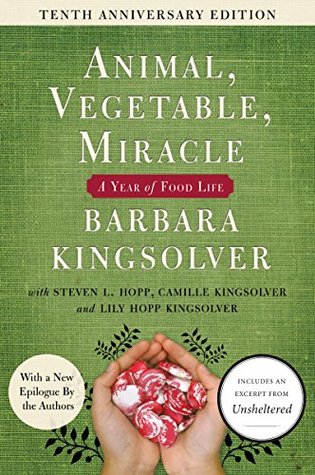
animal-vegetable-Miracle-barbara-kingsolver-book-review-jeanne-blasberg-best-books-diningI recently read ANIMAL, VEGETABLE, MIRACLE by Barbara Kingsolver about her family’s year-long experiment dining locally, both from their own farm as well as sources within 100 miles of their home. It was the year she and her husband moved from Arizona to Virginia with two children. The entire family signed onto a pact to become “locavore.”  I found it inspiring, written with a sense of humor while chronicling the challenges, hard work, and planning that comes with farm life and eating locally. There were unmet cravings for sure, but also showers of abundance and joy while the family discovered that buying, dining on, and sharing food within a local economy built health, community, and a connection to place.

Any vegetable gardener will tell you the only thing more satisfying than eating one’s home-grown produce is sharing it. Before cooking, one might say it is the truest expression of love. I’ve experienced that joy on a small scale for years, but the dream that led to our investment in Flynn Creek Farm was wanting to do it on a larger scale. I’ve learned small farms like ours are slowly disappearing. This is because in order to be competitive on price, and to sell food as cheaply as Americans have come to expect, big mechanized operations  specializing in a few crops with lower amounts of labor are more likely to be profitable. Large scale operations, however, use a lot of energy and water, and typically rely on chemicals, not to mention the impact of transportation to market. They tend to lack biodiversity, and around southwest Wisconsin you see a lot of corn or soy for animal feed or for the ingredients in processed foods. Besides damaging the topsoil, many of the practices of big operations have had ill effects on people’s health.

For the past eighty years, our country has been on a terrible diet. It is something most of us are aware of, yet how to source and prepare healthy ingredients four our dining habits is time consuming and expensive. It has become a privilege of the wealthy to have access to healthy, fresh ingredients. At Flynn Creek Farm we are hoping to change that.

Growing up in the seventies and eighties, my mother was a housewife convinced by marketers on the time saving benefits of canned and packaged food. As a result, I grew up on sugary cereals and SpaghettiOs. She would cook a real meal from scratch on occasion (if you consider a Campbells cream of mushroom soup a natural ingredient), but when my father was away on business and it was just the two of us, I spent many evenings dining on a lot of frozen dinners. Later, as a teenager and young adult struggling with weight gain, I was determined to take control of my diet. In the process I learned a great deal about nutrition, and an ensuing distrust of what I’d been raised on as well as what was offered in school cafeterias and college dining halls. The feeling that the system was conspiring against me combined with other factors and resulted in a debilitating eating disorder.

Even as I recovered from the worst parts of that illness, I continued to view the middle aisles of the grocery store as chemically laden junk marketed by men on Madison Avenue. The same men who touted the perfect female body made it almost impossible to be healthy.  It was the same patriarchal system that blinded the average consumer from knowing the truth about where food came from.

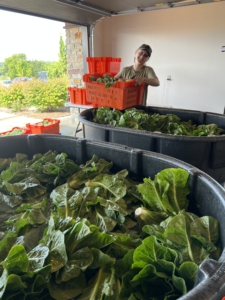
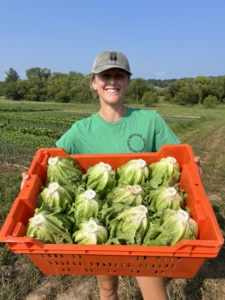
Fast forward to September 2023 and the elation I’m feeling as we harvest produce at Flynn Creek Farm and deliver it to Forage Kitchens, the small fast/casual dining chain that is our partner. Those baby seedlings we watered, put in the ground, and took care of are being served in people’s grain and salad bowls.  It’s both the high quality of our veggies and our value of being  100% transparent that gives me great pleasure.  I remember that first team lunch meeting at which we recognized our lettuce and cilantro in our salad bowls and, well we got a little giddy. An average consumer can walk into Forage restaurants, and for about $12, receive a meal packed with nutrition and grown with a lot of love. Even though this summer has been a pilot year, including all the start-up bumps in the road, sharing our food with the community has everyone really jazzed up and ending the season on a high.

We’ve embarked on this enterprise well aware that as Americans, we’ve been trained to have low standards around most meals. People are stretching a budget and extremely busy and, as a result, view eating as a way to get full. We’re betting on the fact that delicious and nutritious will win in the end.  That’s this farmer’s side of the bargain at least, the rest depends on the consumer. When the topsoil, the community, and the climate are at stake, then eating locally is a no-brainer. Flynn Creek Farm hopes to convert consumers who care exclusively about great taste as well.

In addition to ANIMAL, VEGETABLE, MIRACLE I take this moment to recommend a couple of series and films that are streaming. CLARKSON’S FARM on Amazon Prime is one I’ve been both laughing along with and cringing with uncomfortable recognition.  For a less jocular insight into the food system, watch episodes of ROTTEN on Netflix or a documentary titled POISONED.  And don’t be intimidated by a 12 month family pledge to eat local, try it yourself for thirty days (preferably not during the dead of winter)!!

The Harvest

The essay “The Harvest” originally appeared on Jeannie’s Substack. Subscribe here for monthly updates!

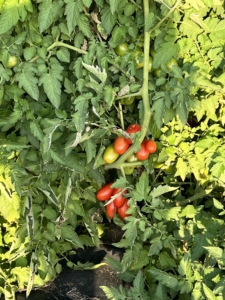
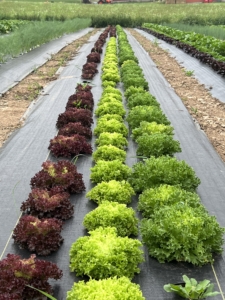
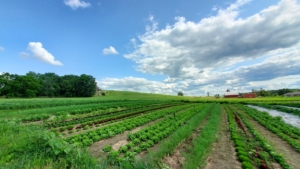
Despite the delays and the drought and the infrastructure challenges, the veggies were planted in the field. The beds were weeded, watered, and well-tended. For the past month beautiful produce has been harvested for Forage Kitchens, a local fast-casual chain of healthy restaurants. Romaine, kale, basil, Thai basil, cilantro, parsley, peppers, salad mixes, green onions, fennel, and so many beautiful cucumbers! This all represents a proud moment on our farm, happily coinciding with nature’s o

verall abundance in August.  For me, there is something about the bird’s eye view of our maturing beds now brimming with foliage of different heights and colors, set against the neighboring hills of corn and hay that represents to me, a most beautiful work of art, a tableau of wholesome goodness.


It is harvest time for our commercial veggie crops by the farm crew, but we are also experiencing the overall abundance of late summer. It is August and the blueberries and blackberries are perfect for picking, black cherries are falling to the ground, mushrooms are begging to be foraged and there are edible greens everywhere. The other night we dined at a neighboring farm where the meal included wild spinach, dandelion greens, wild cherry tomatoes and foraged mushrooms. As city folk, John and I are overcome with the opportunity to reclaim our nutritional birthright. It is powerful and feeds our mission to produce nutritionally dense food for others, helping to make it the norm rather than the exception in our nation’s food system.
This summer I read ANIMAL, VEGETABLE, MIRACLE by Barbara Kingsolver (long overdue for me and highly, highly recommended reading!!) which documents her family’s move from Arizona to a farm in Virginia and their commitment to eating locally for one year.  I love the term locavore as it connotes a diet based on what is regionally available and in season (unless of course, one has stores in the root cellar freezer.) It enhanced my excitement to eat off our land, on food from our neighbors or a nearby farm’s csa.  I have been waking up surrounded by the abundance of the harvest, feeling so much opportunity and optimism that our partnership with the land is working.


It may sound corny, but writing is similar to harvesting because in order to write regular blog posts like these, one must look back at a bevy of experiences and emotions, cultivating ideas and observing themes.  More than a journal of what is happenings on the farm, my aim is for these essays to make meaning – Why am I drawn to this place as if it is a magnet, and in my late fifties, to this lifestyle? People constantly ask do you have family in Wisconsin. And the answer is no, exactly why we are here is hard to explain, I see the confusion on their faces, would you understand that it had a lot to do with intuition? Maybe I’m drawn to the badassery of a self-reliant way of living where growing, sharing, and trading make trips to the grocery store less and less frequent. Maybe it is the constant learning, identifying plants and fruit trees as well as the varieties of weeds that love our fields, just experiencing the month to month changes, or maybe it is the array of daily challenges and the requisite problem solving. When I was a little girl, I wanted to be a scientist or an “inventor,” and it seems like this is my life’s interpretation of that dream.
The Planting

The essay “The Planting” originally appeared on Jeannie’s Substack. Subscribe here for monthly updates!

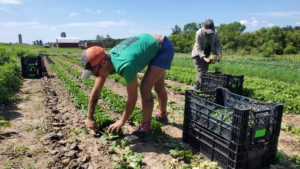
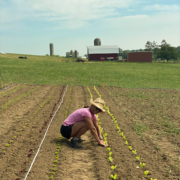
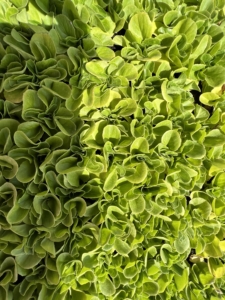
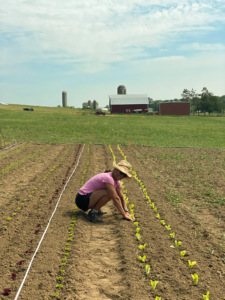
On a day when the news is filled with stories of AI destroying humanity, planting lettuce is a good antidote. Farming, after all, is a grand gesture of hope. On my hands and knees in a field of lettuce, planting what will be in approximately 40 days, the foundation for somebody’s grain bowl equates to faith in the future, or at least the near future. It involves tender care, weeding, and watering and I can only hope the diner will eat every last morsel, not be in such a hurry that they push the lettuce aside as scraps.

When I’m not helping on the farm, I’m currently reading ORWELL’S ROSES by Rebecca Solnit, and reminded that even the most dystopian authors, writing during the Great World Wars found solace in a small cottage in the English countryside, tending flowers and harvesting vegetables for personal consumption but also for sale. I find myself in Wisconsin for similar reasons, craving solitude, while also wanting to be a cog in returning to an agricultural system that makes change for the better. I have met neighboring farmers since being on Fritz Rd, primarily women, and they are so attuned to nature, to their livestock and the plants surrounding them. I truly admire their skills and ability to be self-sufficient and survive off the land. Even three months here have provided so many lessons.


Farming is a spiritual act as expressed in agrarian literary tradition of Aldo Leopold, Wendell Berry, even Lord Northbourne whose OF THE LAND AND SPIRIT was lent to me my dear friend over the winter. As I’ve made obvious, I have an ambition of writing about our experience here. Specifically, of what it is like to get started since that has been the most intimidating, gut-punching part of the process. John came home from a conference recently where the key-note speaker and well-seasoned farmer began his remarks with a joke, “Do you know the difference between a fairy tale and a farm tale?” Nobody offering up a reply, he continued, “A fairy tale begins with Once upon a time…  but a farm tale begins with, you just won’t believe this shit…”  Nice to know we are not alone.


In no way do I want to romanticize this stuff. To arrive on the land and see it as nothing but a pastoral remedy is a terribly privileged point of view. Generations of people have literally been slaves to the land, and even when not actual slaves, have worked tirelessly. There are people who don’t see farmland as beautiful but only see the poverty and misery.  Our crew this summer is working under the most intense heat, no rain, the work is hard. So don’t be surprised if what I write doesn’t harken to A YEAR IN PROVENCE by Peter Mayle or UNDER THE TUSCAN SUN by Frances Mayes, nevertheless it will be authentic and honest.

For starters, we have laid down thousands of dollars’ worth of cover crop seeds and haven’t had any rain in over a month. That we were on the verge of beginning an operation in our barn only to discover it is full of lead paint. It is so hot that that dogs don’t want to go outside, and the breeze is one of those hot ones that makes you feel a little mad. There is the solitude and the existence of a crew you are paying for months before you see any income. You must find room in your brain for this impossible combination of urgency and patience. For the natural order of things that is so much grander than us all and will completely outlive us, while doing small bits every day. Instant gratification this is not.  Then again, nobody who needed instant gratification would become a writer. Readers sometimes feel as elusive as the diner who doesn’t feel like eating that lettuce leaf.

Still, being surrounded by nature is inspiring and the metaphors are plentiful.

The Water

The essay “The Water” originally appeared on Jeannie’s Substack. Subscribe here for monthly updates!

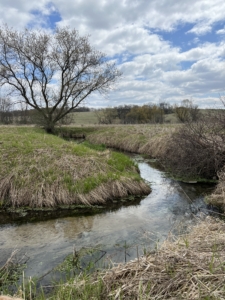
When we first stepped foot on Flynn Creek Farm, there was a relatively modern home on the property, constructed in 2014, in addition to a not so new barn and an equipment shed.  There were agricultural fields, rocky forests, and land in a government conversation program. We saw abundant opportunities for produce fields and greenhouses, pastures and paddocks for livestock, a wash/pack facility with a culinary kitchen and offices, space for events, as well as opportunities for a few mobile tiny homes sprinkled throughout the trees so that we might become an agri-tourism and education destination someday.

After closing on the property, the planning began.  We considered land contours, accessibility, while hoping to create a campus aesthetic. My city-girl brain said start with the buildings and then call someone to come hook up the basic services. Very naïve and embarrassing to admit.

Start with the well.  As an author obsessed with writing about biblical women, it is quite ironic I had a major oversight regarding. My Hebrew name is Miriam, no less, after the woman who provided water to the Jews as they wandered into the wilderness. Water is life-giving and Genesis is replete with scenes of women at wells. GOD miraculously places a well in Hagar’s line of sight as her infant son is dying of thirst. Rebekah and Rachel meet their future husbands at “the well,” indeed springs of water are the setting for many important interactions and the appearance of water or rain in a biblical story is indicative of GOD’s favor. Everything begins with the well.

That said. I hope the challenges we are having with the county over our well placement is not a bad omen, but rather a message to take this step more slowly and carefully.  Given water’s increasing scarcity, the access to it will be more important than any of the buildings we might erect. I write this after the region has experienced one of the driest Mays on record and there are frequent news reports of cities and states negotiating water rights, from The Colorado River to the Great Lakes.

Our permit to drill should be approved any day, is what I hear, albeit in a revised location and requiring a much deeper well than originally anticipated.  It will be the last thing we get done, whereas I had assumed it would be the first.  It is holding up our operations more than any construction delay we are contending with. The anticipated well location will require a more powerful pump, a stronger current of electricity, more piping, the list goes on. Even though the regenerative agricultural practices we are employing use less water and sequester carbon, growing veggies requires dependable irrigation. We are creating retention ponds in addition to capturing rainwater to supplement what we draw from below, but there is no getting around our need for a well.

Water is obviously not just an issue for our farm, but at the core of our nation’s agricultural system becoming sustainable. Everyone has witnessed a more prevalent pattern of drought and flood. Land gets parched and then top soil runs off in torrential storms. Farms both large and small need assistance transitioning toward practices that conserve water. Shame on me to get so caught up with a greenhouses rising from the earth without fully remembering the the key to all life is the water.