
Wishing You Less in 2022: What’s Your New Years Priority?
As we move toward another new year, I’m considering what’s a priority. On a recent Saturday afternoon, my husband and I were walking in Boston’s Back Bay and shared a stunned expression. We had a free afternoon in front of us. No plans or commitments – I hadn’t felt like that for about twenty-five years. What were we forgetting?
It certainly had something to do with a COVID variant cancelling plans, our kids moving on, and parents passing. We had spent so many years as that middle generation, sandwiched between our kids’ needs and activities (which were often very fun, don’t get me wrong) and spending time with our parents (also a blessing). Now that those two slices of bread are gone, we’re just a piece of cheese and a slice of turkey coated in mayonnaise, looking around and wondering what to do.
Maybe it’s not a great metaphor for a couple of vegans, but it’s a fun one! And it’s apt for the crossroads we’ve found ourselves at. The easy solution would be to find something new to be our bread. Or perhaps to try out a substitute—a bun or a tortilla. But the upheaval of the past few years has also taught us to value simplicity, adaptability, and inventiveness. Now, instead of reaching immediately for something to add to our lives, we find ourselves pausing to consider. We wonder: what we might become without any bread at all?
I’ve written previously about reassessing just about everything during the pandemic, the most significant of which was our family home in Boston. We ended up selling it this summer along with almost everything inside. These days, when people ask me if I miss it terribly, I tell them what I do miss is my kids being in elementary school and middle school, all the running up and down the stairs, dinners around the dining room table, them doing homework at the kitchen table while I cooked and quizzed them on vocab. If I can’t get those years back, then I am okay letting go of the house. Downsizing is what people do when they get older; they simplify. However, I would advise people of any age to wake up each morning and choose who and what they want to keep in their lives.
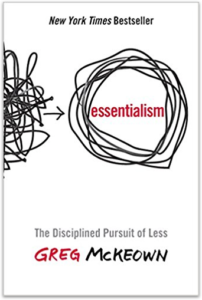 In Greg McKeown’s recent book Essentialism: The Disciplined Pursuit of Less, he highlights how much energy can be redirected to the pursuit of our highest priority when energy being spent on “non-essential” issues or tasks is cut back or cut off entirely. (In other words, there’s no need to keep a toaster or a panini press when your bread has flown the coop!) There was a time when I said yes to too much, so while you might not really need a book to help you say no, it is affirming to see best-selling books espouse this movement.
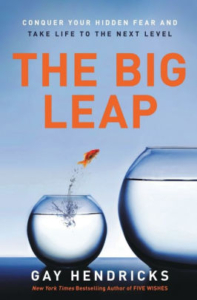
While I’m plugging motivational books, another one that has made an impact on how I think recently is called The Big Leap by Gay Hendricks. It can’t really be summed up in a simple prescription, but the gist is training the brain (mine had defaulted to worry mode) to extend periods of contentment. Human beings are wired to self-sabotage when things are going too well for too long because of an inner fear or feeling fundamentally flawed or undeserving. The goal is to shed those shackles and allow things to go well all the time, the pursuit of a life full of creativity and joy and discovery in the genius zone. Although these two books weren’t suggested by the same person or at the same time, there’s something to be said for the synchronicity of picking up simultaneously at a time when they spoke to me.
 A funny aside in McKeown’s book is that at its conception, the word priority was intended to describe the single most important thing in one’s life. It has only been in the last hundred years that priority was made plural and it became acceptable for people and organizations to have multiple priorities.
Tempting as it may be to turn back the clock on this particular linguistic shift, the truth is it’s unreasonable to expect ourselves to whittle our contemporary lives down to a single priority—no matter how devoted we may be to minimalism and downsizing.
Perhaps in other times and places, the various aspects of our lives were more unified. We farmed to survive. We lived where we worked. The whole family was in it together. But despite the recent shift, for many, toward work-from-home, the spheres of our lives are no longer so intertwined, and often we find ourselves pulled between them.
So maybe the plural priorities isn’t going away any time soon. But understanding this etymology can be a reminder to ourselves that plural doesn’t have to mean infinite. We can place limits on our lists. Perhaps it would be more realistic to suggest focusing on a single priority in each main area of life. Some people might take the “4 burners” approach: family, friends, work, and health. Personally, I like the idea of three focus points.
For the foreseeable future, these are mine:
- My family
- My writing/artistic life
- Investing in regenerative agriculture
What is this agricultural interest on your list, you might ask? Am I reverting to that all-inclusive farm life after all? Stay tuned and suffice it to say that it’ll be a great story. But throw it also in the bucket of assessing our lives, deciding we have another big chapter left to complete and one priority we have is leaving the planet a better place.
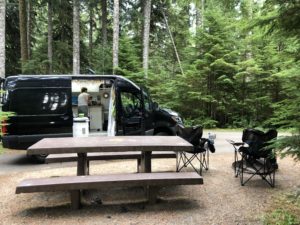
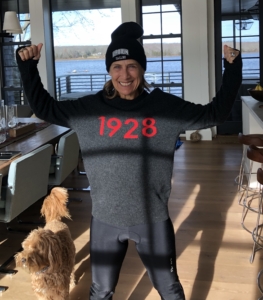 Tomorrow I begin driving to Madison, WI, then through Iowa and Nebraska to Denver, Colorado and ultimately to our new home in Park City, UT. Packing was simple because I don’t need much. (Lessons learned from #vanlife with our daughter.) My husband gave me the greatest sweater for Hanukah, the numbers 1928 splayed across its front. That number is special to me so I see it as good luck, a connection to loved ones, and just pretty damned cool that he found it in a store and snatched it up knowing it was meant for me. That is love. It means so much to me I told my husband I will likely wear it everyday of the entire winter, so that solves a lot of fashion questions. I guess that makes it my single priority sweater!
This year has been all about cutting back, revising. In fact, I just sent a major revision of my novel-in-progress to my fellowship mentor at Bookends which has been an incredible experience to date. But the revisioning doesn’t end there. As writers, we learn that a new draft means completely re-seeing what’s come before, sometimes letting go of old ideas and plot threads, sometimes whittling away the words that bog it down. The same practice has imbued my life outside of writing.
This next cross-country journey (including all the side-winding) would not have been possible if we hadn’t let go of that which was holding us back. Embracing new dreams, reinvention, call it what you want, it is a powerful drug.
So as this breadless cheese and turkey pair face the future hand in hand, we’re no longer thinking, how do we fill in the gaps to go back to being a sandwich? These days, we’re wondering what we could become with everything else stripped away. Might we melt ourselves into a casserole or roll up into a roulade? How can we highlight the ingredients we already have, rather than overpowering them? No matter what we make of it, we’re facing the future a bit lighter, a bit less, and with plenty of room for levity, possibility, and hope.
I’m looking forward to the report I’ll write from the other side!!
Wishing everyone safe travels in the new year along with peace and good health and freedom from your clutter.
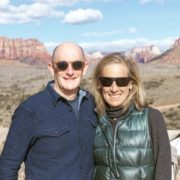
 Before I delve too deeply into the drive, I want to reiterate how healing the trip was in general. I recently read an article by
  We left Park City on March 20th, with an itinerary that would take us through some of the most lauded locales of the Southwest. Our first stop was Zion National Park where we’d elected to try “glamping” at Under Canvas, yet one more chance, we thought, to commune with the nature that had been so influential to us throughout the winter. But glamping, it turns out, isn’t all that glam with the March chill creeping in and two dogs demanding our attention. The wood burning stoves might’ve kept the cold at bay, but the need to refill them every 90 minutes or so led to something of a sleepless night.
 (One other
  From Flagstaff we drove to Santa Fe. Departing Arizona and heading into New Mexico continued our experiential lesson in expansiveness. The desert really felt deserted. It was nerve wracking, but also extremely beautiful. There was always this fear just below the surface — what if we were to break down here? How would we ever get help? For a city person to drive through hours and hours of nothing is quite something. Accustomed to 24/7 road side assistance, the ability to order anything and receive it quickly, the lack of apparent help or support in the event of danger took us back to an earlier era of self-reliance. With a survivalist’s frame of mind, the red rocks and landscape were more than a beautiful backdrop. They spoke to me, “We are more than just iconic scenery, you must live to tell about it. You must have gas, you must have water, you must know how to repair your own car.” The thrill of the road trip was wrapped up in the beauty, for sure, but making it through to the other side felt brave and like an accomplishment too.
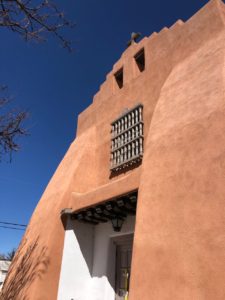 “Of course, just about every gallery in Santa Fe is dog friendly.”
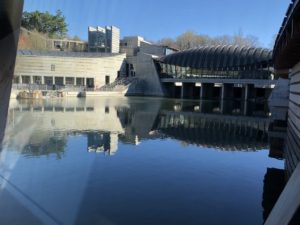 Crystal Bridges’ curation provided a critical commentary on the approach taken by exhibitions such as those once hung by “The Eight” of the Santa Fe School in the early part of the Twentieth Century. At Crystal Bridges, traditional American art was hung alongside Native American art and African American art of similar time periods offering a more complete and complex picture of historical periods and for me highlighted the bias of the white lens through which many museums are curated. It was a timely lesson, completely in line with what I was learning in DEI training I was doing around anti-racist approaches art and cultural institutions should take. Something about being in Arkansas was liberating, maybe freeing the curators and educators there from an East Coast, “Old School,” point of view with regard to telling American stories. I so appreciated our time in this museum. It felt like the curators at Crystal Bridges were really on to a new way of hanging art and educating the public.
 As we drove out of Arkansas, we listened to Alice Walton’s audio guide of her collection, which further emphasized what we had felt walking through the galleries. Wow. She was not a woman raised on museums or with an Art History education. She learned much as a collector and had a very intuitive and contemporary take on what she purchased for the museum. She had expert advice yes, but she collected with a desire to have strong female representation and to represent artists with differing perspectives. For this Art History student from Smith College, raised on our American cities’ major museums and the great European masters, her point of view was not only refreshing but electrifying.
 We’ve been back in Boston for three months now, and I miss the red rock, the Ozarks, the mild weather, the unexpectedness. As I write this most of that landscape is in the midst of a drought and record heat wave. I think about the expanse of desert in such extreme conditions and I worry about the lack of water. I wonder if our potential relocation west would add to the problem of this fragile landscape or if we could settle with sensitivity, with appreciation, and a desire to do no harm?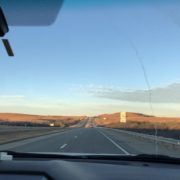
 Maybe it was an expression of freedom, or, said another way, a need to demonstrate control. But in the end, the work-from-home mandate gave us choices that I wanted to take advantage of. My husband was game to work remotely as in “really remotely,” knowing 1) I’m my best self on a road trip and 2) to make sure I came back. Haha (but not really). In all honesty, neither of us had seen our country’s interior up close, most of our travel consisting of airport arrivals and departures with drives directly to some destination or another. We never got to pull out the map and make a plan, to see how everything is connected.
 Over Thanksgiving, we made our big meal into a culinary adventure because the Hilton Head beach house kitchen was equipped more for chips and margaritas than a traditional feast. Our meal took on a low country theme, cornbread, pecans, avoiding any comparison to “home.” We watched “Midnight in the Garden of Good and Evil” before a walking tour of Savannah.
 We drove north through Virginia on a scenic route we devised on our own, listening to
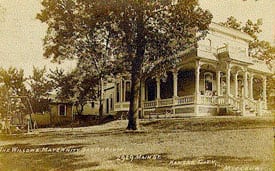 Having swapped out the golf clubs for ski equipment, we made it all the way to Pittsburgh that first night in an attempt to beat out bad weather. After Pittsburgh we spent nights in St Louis, Topeka, and Colorado Springs. We made some longer detours through Dayton and Kansas City where we went for much needed walks and Whole Foods replenishment, even a visit to the site of the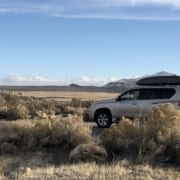
 There’s something about going
 Maybe I’m just a sensitive creature, possibly even bordering on Sensory Processing Disorder, but I’ve always resented loud noise and its imposition. You see, I grew up in a household with many televisions. Nothing big and high tech — it was the mid ’70s and early ’80s and we had about six channels to choose from. Our TVs had antennae, no cable hook ups, and small, rounded monitors relative to their chunky plastic casings. We had an RCA color set that held a place of prominence in the family room and a couple little portable black and whites my mother would stow on her bathroom counter or by the kitchen sink. She puttered through the house to the sound of the Today show, Bob Barker and the Price is Right, and an afternoon marathon of soap operas. At 5pm, the local news announced it was time to start making dinner (and socially acceptable to pour a first glass of wine). Later when we got cable, my father kept a TV on his desk with the monotone voice of news and markets keeping him informed.
 I first became really aware of my sensitivity to sound when my husband and children and I moved to Switzerland. In Zurich, there are laws against making noise on Sundays and in the middle of the day (like a nationwide observance of nap time) to the extent one could be fined for running a washing machine or cutting one’s grass. It seemed a little over-reaching when we first arrived, but I quickly became a fan. Just as with my time in Colorado, I appreciated the silence like the missing ingredient I had been searching for all along. And when we returned to Boston, I noticed with even more acuity how much sound is thrown into the atmosphere.
 I gained enough wisdom in 2020 to know that is enough. More than enough, and how lucky I am. I learned to stop making plans out in the world, trotting the globe, and to look for solace in my inner life, reading and writing, thinking and listening to audiobooks and walking, just breathing. This year, I will leave the rose-colored glasses behind, the naïve, blind privilege that assumed all my tomorrows will play out as I want them to, of course they will, why wouldn’t they? There is definitely a sadder, subdued flavor to life now and what I foresee in the new year, but in a lot of ways it is truer, more real. The greater forces in the universe have imposed humility on a population that increasingly expected instant gratification and service at its fingertips. This time last year, John and I accepted a
  I’m still just that little girl afraid of the dark, wanting one more book before bedtime to ward off the unknown, and the promise of a goodnight kiss. As a grown up, I’ve created
 “At home” always

 The summer months brought more events, and I was able to drag family members along in ways I never was able to before. While working on a jigsaw puzzle, my son and I tuned into a
 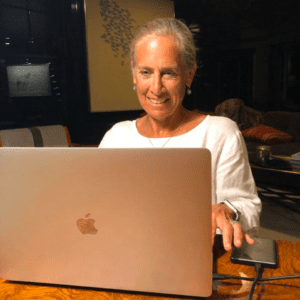 And I am not alone. If you are a book lover or lifelong learner, I’m sure you have had similar experiences. If you want a few tips – please know it is Book Festival Season. I am biased toward the
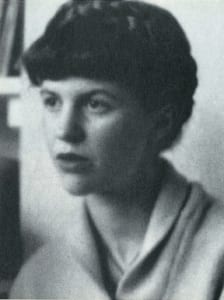 Sylvia Plath was born in Boston in 1932 and graduated from Smith College in 1955. She was the beneficiary of a scholarship from the Smith College Club of Wellesley. She died in England in 1963, the same year The Bell Jar was published. Sylvia married Ted Hughes on Bloomsday, June 16. From what I have read, their marriage was troubled early on.


