Beyond Admissions: The Campus Novel
This article was originally published on Medium.com.
Disclosure: This page may contain affiliate links, meaning if you decide to make a purchase through one of these links, I may make a small commission (at no additional cost to you), which I will donate to literary organizations in Boston. Thanks!
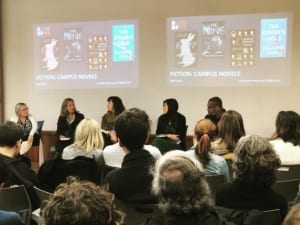
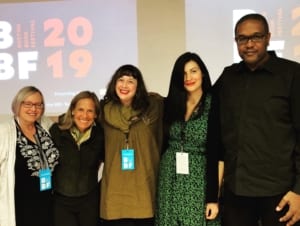
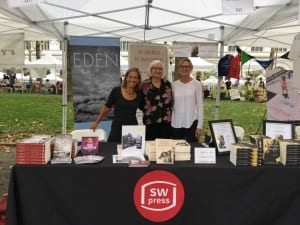
I sat on a panel last weekend at the Boston Book Festival with three incredible authors of recent releases to discuss “The Campus Novel.” Long-held favorites in American literature, campus novels are set in academia with protagonists coming of age among a variety of pressures. Schools, after all, have long provided ripe settings in literature — think THE LORDS OF DISCIPLINE by Patrick Conroy. They are convenient microcosms, mysterious islands unto themselves with specific codes of conduct and traditions. If a writer’s primary objective is to ‘world-build,’ then campuses provide a great head start.
 In addition to my novel, THE NINE, the Boston Book Festival panel included CJ Farley with his novel AROUND HARVARD SQUARE, Mona Awad and BUNNY, and Elizabeth Ames who wrote THE OTHER’S GOLD. While THE NINE is set on a fictional boarding school campus, AROUND HARVARD SQUARE and THE OTHER’S GOLD are set on college campuses, and BUNNY portrays one young woman’s experience in an MFA program. Our moderator, Lisa Borders, kicked off the discussion with the ways we had each spun this recognizable genre, however, CJ Farley was quick to point out that the four novels, with regard to subject matter at least, were more similar than different.
 There was head nodding on the stage. We were, he continued, all dwelling on the theme of exclusivity and groups — whether cliques of friends, societies (secret and otherwise). Our protagonists are disheartened as they meet continuous tests of acceptance inside their respective academic settings. And while our young heroes and heroines may have been conflicted about these groups at first, they ultimately wanted in. Whereas one (a parent for instance) may have assumed gaining admission to the likes of Harvard was success in itself, our characters are disheartened with the continuous tests of acceptance that are set out before them. BUNNY and THE OTHER’S GOLD are interesting in their deep dive into the world of female friendship and the intense bonds (for better or worse) that are created on campuses during early adulthood. After touching on the theme of acceptance, loyalty and betrayal were obvious follow-ups in all of our novels.
 Farley talked about the seemingly endless interaction with gatekeepers. His novel is about a young black man attending Harvard and his discovering ways he did not belong. College admissions opens the first gate — and then the fun begins. Our panel discussed the tension between insiders and outsiders — a timely topic with college admissions scandals in the news. Timely, but also timeless — we talked about the fact there have always been those with special access (legacies, and athletes) — groups who seem to hold a master key. Indeed, a protagonist’s ability to navigate new worlds within a campus’s walls where learning the secret handshake is hard, creates confusion and mystery and is at the core of the campus novel genre.
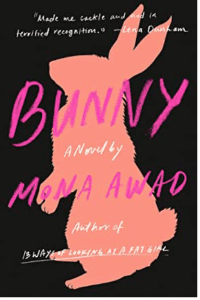 In BUNNY, Awad shares my fascination with secret societies — their power of seduction — and underworlds facilitated by tunnels and dark places. In the vein of DEAD POET’S SOCIETY, or THE SECRET HISTORY, we write about primal sisterhoods and fraternities with incantations and candles glowing in the dark, taking us back to an impressionable time in life — one of all night sleepovers, Ouija boards, and the potential for Lord of The Flies type cruelty.
Besides the aforementioned novels on my 2019 Boston Book Festival panel, there have been a number of campus novels to hit the scene recently, attracting my attention for obvious reasons!

THE EXPECTATIONS by Alex Tilney is set at a boarding school in the 1990’s, where Ben and his roommate Ahmed are from vastly different backgrounds, one dressed in Brooks Brothers classics, attending the school as his Yankee birthright, while the other is from a Muslim, oil-rich country, and dresses in custom suits tailored-made on Seville Row. This novel paints a stark contrast between insiders and outsiders, with material wealth and parental pressure providing potent external stressors.
 In THE GIFTED SCHOOL, Bruce Holsinger creates an atmosphere of intense competition among parents in a Colorado town when word spreads that a new school will be opening with room for gifted students only. With contemporary, fast paced prose, this novel takes a heartbreaking look at what we’re doing to our kids in the name of getting ahead. Hannah Webber, a major character in THE NINE, is that type of mother. From a modest background with parents too busy to pay much attention, she works tirelessly for her son’s acceptance to a prestigious boarding school, to have ‘more” in life. Unfortunately, her drive is rooted in her own insecurity and wanting ‘more’ out of her own life.

ALL THESE BEAUTIFUL STRANGERS by Elizabeth Klehfoth, is about a young woman plagued by dark secrets in her family who joins a secret society at her New England boarding school. Her secret group called “The A’s” is intent on terrorizing the administration and faculty in much the way “The Nine” are. The trope our novels share is one of brilliant youth showing up the adults in charge, sticking it to the man, one where students become teachers.
Besides all the recent releases now in the world, there are the classic campus novels that can’t be missed. CATCHER IN THE RYE, A SEPARATE PEACE, and OLD SCHOOL come to mind. THIS BEAUTIFUL LIFE by Helen Schulman and TESTIMONY by Anita Shreve were two that influenced my conception of THE NINE. They are both campus novels that include a mother’s voice, of women who could only sit back and watch as their teenage sons made mistakes. Just as the litany of adolescent insecurities is a long one, the syllabus of great campus novels will last a lifetime.

 As I home in on the publication date for my second novel (
 5) Celebrate every small victory along the way

 This summer, in an effort to focus just as much on the generative side of my nature as I knew I would on the promotional side (remembering my experience with my debut novel,
 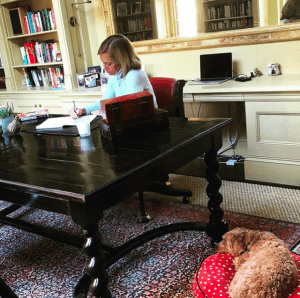 I’m sure many authors read the above like it’s obvious – of course you keep up a writing practice come hell or high water. That’s what you do. But I bet there are others reading this who like the reminder, indie authors like me who manage much of their own promotion, schedule their own book appearances, and do a ton of footwork – authors like me who are relatively new to this and might lose sleep wondering if there is something else that should be done to give a book the best chance at being noticed. I don’t want to live the next several months with that chatter in my head and the consequential lack of focus.
 On our recent
 The Ritual of Writing


 I accept invitations and view every opportunity to discuss my book as a blessing. I have fully immersed myself in the literary community in Boston. I attend readings. I take classes. I am workshopped, and I accept feedback. I blog and submit essays for publication. If I am writing I tell other people not to bother me. My business cards read “author.” I attend conferences. I approach people. I watch what the authors I admire do and I try to emulate them. When I am not writing, I am reading. I review books.
 Reject those who are rejecting you.
 n for a couple weeks but there are images from Utah that I’m carrying close through this cold and grey New England spring. Not really images, more like colors: white snow, blue sky, and green trees…. And then there’s the red.
 sides being the birthplace of Ruth (one of my biblical heroines), it is also the last bit of wilderness where the Israelites stayed before entering the Promised Land. It is where Moses’ Exodus story ended, where he died and was buried, never able to enter Canaan himself.



 The following article was originally published on

 I scoffed at the parents, briefcases in hand, dressed smartly, waving furiously and tearing up at the “Goodbye Window.” I donned an ensemble of sweats, maybe even the t-shirt I’d slept in, and a hat and down jacket long enough to cover the entire mess. My eldest son was three and a half and I’d drop him each morning in the ‘green room,’ his younger siblings in tow. Sometimes literally drop him.


