
Witness by Jamel Brinkly
Witness: Stories by Jamel Brinkly
This review originally appeared in the New York Review of Books.
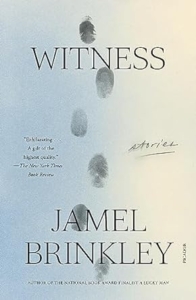 A collection of ten short stories set in Brooklyn, NY, Witness: Stories is populated by characters navigating relationships with friends and family, both living and not. The title is that of the final story in the collection, emphasizing the act of witnessing, although personal and subjective, is a human responsibility.
Brinkley’s characters struggle in a hazy present where gentrification, workplace bias, and police injustice color their days. However, their inner wounds stem from family members or a family member being absent or increasingly unrecognizable. In the opening story, “Blessed Deliverance” a group of white people set up an organization for rescued rabbits in the park with a neighborhood homeless man as lead volunteer. The teen protagonist and his gang of friends are amused by the many levels of absurdity surrounding this enterprise.
In “Comfort,” a woman’s brother is murdered years earlier by a white police officer, an incident she plays over repeatedly in her mind, including the implausible explanation given by the policeman at trial. Simone is having a challenge managing her present day while in dialogue with the deceased. Many of the stories in Witness feature ghosts, implying that much of what one witnesses is inexplicable. In Brinkley’s collection, witnessing is highly experiential, involving more than simply sight.
Teenage characters bear the burden of their parents and parents bear the burden of their children. Embarrassment, shame, and regret swirl about these works, an in the very oxygen the characters breath. In “The Let Out” a young man is pursued by his father’s ex-lover, a woman who, he comes to understand, was, even in her absence, a significant member of his family. In “Bystander,” Anita and her daughter are in a devastating battle of wills that has Anita denying she even has a daughter to a homeless bystander-prophetess in Prospect Park.
The opening lines in “That Particular Sunday” exemplify Brinkley’s characterizations of the familial:
“There are times when a family has an aura of completion. Remembering such a time feels like gazing at a masterpiece in an art gallery. You might find yourself taking one or two steps backward to absorb the harmonious perfection of the entire image. Or you may be lured by it, drawn to it, inching closer to study every fine detail of composition, the faultless poise with which each element confirms the necessary presence of the others. Take the figure of the son, who hurtles into the foreground of the picture, claiming his position in a web of femaleness, affixing himself to the very center of its adhesive heart, because he belongs there, or so he believes with the unblemished certainty of a boy’s imagination. Like everything else in the image, he never changes. Yes, that is my mother, his presence announces. And those are my aunts, he seems to say. And this- of the girl closest to him, her expression as breathless as his own—this is my cousin. My companion. My closest friend. Her soul is the identical twin of mine . . . They belong to a different elsewhere, a time yet to come, with another father to come, and the circumstances of their lives will frenzy the family, purpling it, cloying it until it is spoiled. Then it will be no different from any ordinary clan. Unpleasant to regard. An eyesore.”
Indeed, Brinkley’s stories insert the reader at the time the family is in frenzy, or just afterward, with characters mourning horrific losses—murders, or death by terrible accident such as being struck by a train, even mourning the absence of family members they were never told about. The stories place us in a setting that is in flux as well, one narrator stating, “We lived in the neighborhood before it was a real estate agent’s dream.” Sure, the stories are peppered with references to gentrification, but they act as a surface layer of disturbance put upon characters who have many deeper troubles.
In the culminating story, “Witness” a fist-person narrator Silas sleeps on his sister, Bernice’s, couch while looking for a job and an apartment. Bernice is not well, suffering an undiagnosed illness, with no help from white doctors. She recalls their mother’s warnings, “When it comes to those white doctors,” Bernice cried, imitating their mother, “always, always, exaggerate the pain.”
Bernice dates and marries a DJ, adding one more person to squeeze into the small apartment as she becomes increasingly sick and eventually dies. Of all the relationships of which Brinkley writes in this collection, those between siblings, although never perfect, are expressed with a degree of tenderness that is moving. His siblings need each other more than they need parents. They are, after all, of the same generation and conspirators in life, in the act of survival, as well as in the human burden of bearing witness.

About Witness:
What does it mean to really see the world around you—to bear witness? And what does it cost us, both to see and not to see?
In these ten stories, each set in the changing landscapes of contemporary New York City, a range of characters—from children to grandmothers to ghosts—live through the responsibility of perceiving and the moral challenge of speaking up or taking action. Though they strive to connect with, stand up for, care for, and remember one another, they often fall short, and the structures they build around these ambitions and failures shape their futures as well as the legacies and prospects of their communities and their city.
In its portraits of families and friendships lost and found, the paradox of intimacy, the long shadow of grief, and the meaning of home, Witness enacts its own testimony. Here is a world where fortunes can be made and stolen in just a few generations, where strangers might sometimes show kindness while those we trust–doctors, employers, siblings–too often turn away, where joy comes in snatches: flowers on a windowsill, dancing in the street, glimpsing your purpose, change on the horizon.
With prose as upendingly beautiful as it is artfully, seamlessly crafted, Jamel Brinkley offers nothing less than the full scope of life and death and change in the great, unending drama of the city.
Read more of Jeannie’s Reviews on her blog, on Goodreads or StoryGraph, or on the New York Journal of Books. For more TBR inspiration, check out Jeannie’s curated book lists at Bookshop.org.
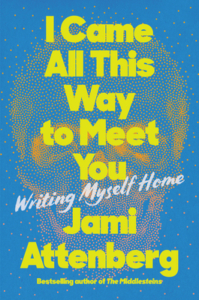 This an especially good read for a writer. It is an inspiring story of perseverance from an author I admire. The opportunity to glimpse into her life and professional ups and downs was a treat. I have participated in Jami’s

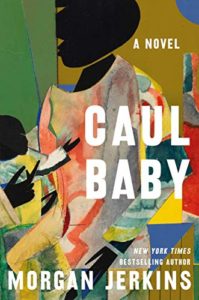 Caul Baby
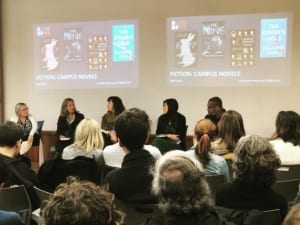

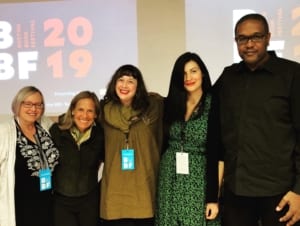
 There was head nodding on the stage. We were, he continued, all dwelling on the theme of exclusivity and groups — whether cliques of friends, societies (secret and otherwise). Our protagonists are disheartened as they meet continuous tests of acceptance inside their respective academic settings. And while our young heroes and heroines may have been conflicted about these groups at first, they ultimately wanted in. Whereas one (a parent for instance) may have assumed gaining admission to the likes of Harvard was success in itself, our characters are disheartened with the continuous tests of acceptance that are set out before them. BUNNY and THE OTHER’S GOLD are interesting in their deep dive into the world of female friendship and the intense bonds (for better or worse) that are created on campuses during early adulthood. After touching on the theme of acceptance, loyalty and betrayal were obvious follow-ups in all of our novels.
 Farley talked about the seemingly endless interaction with gatekeepers. His novel is about a young black man attending Harvard and his discovering ways he did not belong. College admissions opens the first gate — and then the fun begins. Our panel discussed the tension between insiders and outsiders — a timely topic with
 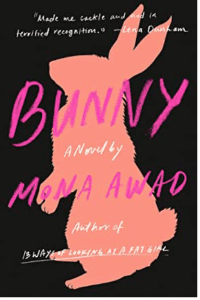 In BUNNY, Awad shares my fascination with secret societies — their power of seduction — and underworlds facilitated by tunnels and dark places. In the vein of
 In
In 

 As I home in on the publication date for my second novel (
 5) Celebrate every small victory along the way

 This summer, in an effort to focus just as much on the generative side of my nature as I knew I would on the promotional side (remembering my experience with my debut novel,
 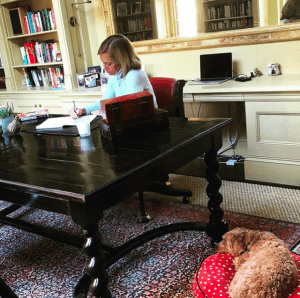 I’m sure many authors read the above like it’s obvious – of course you keep up a writing practice come hell or high water. That’s what you do. But I bet there are others reading this who like the reminder, indie authors like me who manage much of their own promotion, schedule their own book appearances, and do a ton of footwork – authors like me who are relatively new to this and might lose sleep wondering if there is something else that should be done to give a book the best chance at being noticed. I don’t want to live the next several months with that chatter in my head and the consequential lack of focus.
 On our recent
 The Ritual of Writing

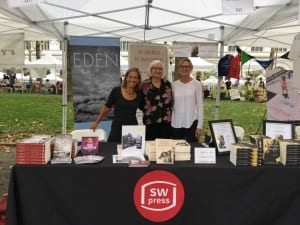
 I accept invitations and view every opportunity to discuss my book as a blessing. I have fully immersed myself in the literary community in Boston. I attend readings. I take classes. I am workshopped, and I accept feedback. I blog and submit essays for publication. If I am writing I tell other people not to bother me. My business cards read “author.” I attend conferences. I approach people. I watch what the authors I admire do and I try to emulate them. When I am not writing, I am reading. I review books.
 Reject those who are rejecting you.
 n for a couple weeks but there are images from Utah that I’m carrying close through this cold and grey New England spring. Not really images, more like colors: white snow, blue sky, and green trees…. And then there’s the red.
 sides being the birthplace of Ruth (one of my biblical heroines), it is also the last bit of wilderness where the Israelites stayed before entering the Promised Land. It is where Moses’ Exodus story ended, where he died and was buried, never able to enter Canaan himself.


