Tag Archive for: Jeanne Blasberg

Sea Worthy

Our boat was loaded down with golf clubs, hostess gifts, costumes for a Saturday night party, bedding, clothing, and cheese and crackers. The dog was at the sitter’s and the sun was high in the sky. Our plan was to stop first at the gas dock in Avondale before starting our journey north along the Rhode Island coast, through Buzzards Bay to Marion, MA. We wanted to  arrive in time for dinner.

When John went to start the engines, however, it became clear there was a problem. Everyone knows that heart-sinking feeling: plans are laid and the forecast is perfect, but technical difficulties arise. “Ugh,” I moaned.

I took a deep breath, preparing myself for the likelihood we’d be transferring everything from the boat into our car and making the trip by land. Not as fun, not nearly as fun. Fortunately, Mike from Frank Hall’s boatyard met us at the gas dock and walked us through the cause of the problem (one of our batteries was failing) and helped us decide whether or not it was safe to make the trip.

It’s been said that the most dangerous thing to have on a boat is a schedule. One must be willing to surrender to the inevitability of things breaking down, and weather and sea conditions stirring up. Time on a boat is meant to be at a different pace than on land and serves to remind us that we are never in control even though we pretend to be.

This time, we decided to carry on, assured the running engine would do its part to replenish the charge of one of our batteries. We’d make it to Marion, Cuttyhunk, Hadley Harbor, Falmouth, and Edgartown before returning to Watch Hill four days later. And don’t you know every time those engines turned over and purred, I said a prayer of gratitude.

In addition to some anxiety over the battery, we’d also heard a lot about how tricky the channel through Woods Hole can be, with ferries and currents and lots of boat traffic. However, by the time the weekend was over we had made a huge deposit in the bank of experience and navigated it three times.

There is something very satisfying about being tested on the water and rising to the occasion, taking the opportunity to strengthen the resiliency muscle. Yes, our destinations were beautiful and so were our friends and the weather, but this particular trip felt more like an opportunity to learn and gain confidence. It was our first time through Buzzards Bay and our proximity to the Cape Cod Canal sparked my interest in cruising even further north. I love to push our boundaries…. stay tuned.

On Golfing and Writing

on-golfing-and-writing

If I look back at the woman I was twenty years ago…

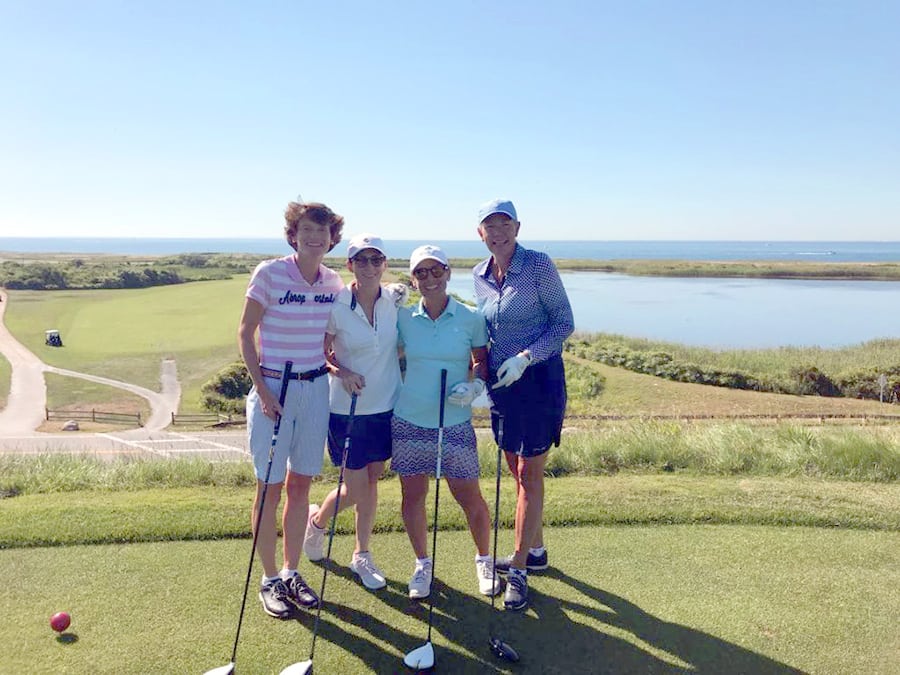
I never thought I’d love golf. I also never thought about the day I’d be staring into my sixth decade on the planet. When you are in your thirties, it’s hard to find joy in a slower tempo. In the same way yoga didn’t appeal to me at that age, neither did a four-hour activity mired with frustration.

It’s only been in the last ten years I’ve come to appreciate the compassion and brain health that comes from a beginner’s mentality. It is so much easier to stick with what we are good at, but there is no growth in that. No matter how much golf I play, I’m always filled with humility and the sense that I have so much to learn. As a writer, reading great books evokes the same feeling. German classes and years of bridge lessons have also put me in the shoes of a beginner, but those practices didn’t stick the way golf has.

That’s because I also love being outdoors. I’ve come to crave the green grass and fresh air, the camaraderie walking the course, my heart rate slowing with the measured, even, pace of the game. A four-hour walk with good friends and no phones: such a luxury in today’s world. Golf teaches me that success comes from taking time and studying my options. Ever try to putt quickly without reading the green? I am a type A personality who multi-tasks and juggles multiple projects at once. Golf has taught me something about concentration and clarity. It has taught me to value precision over power.

Golf benefits my squash and my writing in the same way yoga or meditation does. I like to think of a golf outing as an extended practice in even breathing and intentional thinking. It begins with gratitude for just having the time and the access to play the game. Then, every swing, every new hole is an opportunity to put the past behind and visualize greatness and use positive self-talk. It’s taken me many decades to face down the critic in my head, but rounds of golf have given me millions of opportunities to tell her to go away!

I never thought I’d love golf, I never understood what people liked about it. I can’t believe I’m at an age where I feel this way, but I really do love golf.

Back on Campus – School Stories

back on campusYou’ve probably seen all the photos on Facebook and Instagram – it’s graduation season and I can’t believe how my friends’ children are growing up! Graduations mark a big accomplishment for students as well as parents. Whether its high school or college, it is monumental to have crossed this major finish line.

Our middle son graduated from college on Memorial Day Weekend. It was a wonderful weekend that brought our family together to honor him and all his hard work. There were ceremonies and cocktails and dinners, but what I most appreciated was being on campus.

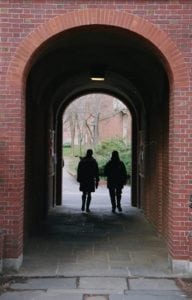
A campus is an island whether its remotely located or embedded in a town. It’s a self-contained world with traditions and a culture and rules of its own. It is self-governing and is populated by a revolving door of young adults. It has its common spaces and its hiding places. It has its own rhythm with quiet mornings and raucous late nights.

As a parent, walking onto a campus, or into a dorm or classroom building, feels like sneaking – dare I say trespassing after all the tuition we’ve laid out! But we aren’t supposed to be there, when we visit we are voyeurs to a special place and time that is no longer ours. And our children, who have license to occupy the space, might do so with the mindset of a traveler on an extended journey. They will be moving on, after all. So, it becomes a first home away from home, an experiment in living alone.

Aah if the walls could talk. The campus has seen growth and love and dissent and resistance. The campus has seen victory and protest. The campus has seen homesickness and nostalgia. The campus has witnessed trepidation and pride.

Maybe that is why, in addition to the romance of an actual green quadrangle surrounded by ivy-laden brick buildings, I have always loved the campus novel. What do you think of this line up:

I devoured all these books. A writing teacher had me watch “The Sterile Cuckoo,” starring a very young Liza Manelli and filmed on the Hamilton College campus. There are the more main stream hits: Love Story, Animal House, and Harry Potter but I think I’ve made a point – drama or comedy, literary fiction, or a trashy delve into Restless Virgins, lots of people find the campus entertaining. There is something primal about a world unto its own – it’s a microcosm of society, with all sorts of “Lord of the Flies” possibilities.

I am working on the final revisions of my novel, The Nine, which is also set on a boarding school campus. When I wrote EDEN, I hadn’t been aware that there was a whole genre around the “saying-goodbye-to-the-family-summer-home” story line. I am well aware, however, there is a long history of great campus novels. They have been a mainstay of American literature since before Holden Caulfield bolted for New York City. Campuses are filled with intrigue and mystery and the adults in charge of them are managing conflict and staving off scandal. It’s ripe, people. It’s ripe.

I would love to hear what your favorite campus novels are and why!!

Thirty Day Challenges- Life as a Laboratory

Thirty days is the perfect amount of time to experiment with something new and different. How often do we look back at a month or four weeks and think, “Where did it go?” Thirty days is a long enough period of time to really accomplish something, while its short enough to convince your mind to stick with a little discomfort. Some people can learn a language in thirty days. I have even heard of some who have written a book!

Over the last several years my husband and I have conducted various thirty-day experiments. We woke at 5am every morning to meditate. We were gluten free for a month and tried various other diets. I swam in the ocean every day, and I wrote a poem or a letter to a friend every day on other go rounds. Some practices stuck, others were tossed out as no fun (see gluten free).

Most recently I conducted a thirty-day experiment in Utah… a self-induced retreat where I detached from my regular life. I planned to ski every morning, write the rest of the day, and go to bed early. First of all, let me state that I recognize how fortunate I am to be able to choose such a thing, but in various ways, big and small, everyone has the ability to make a thirty day change. In January 2017 we leased a house in Park City for March 2018, and it was a good thing we did it so far in advance, because for a period leading up to departure, I was filled with regret and doubt: a combination of having to decline fun invitations and worrying the snow wasn’t good, and then there was the underlying expense of it all.

A month can get committed away if the calendar isn’t safely guarded. That it is why it is important to plan ahead and create an intention around a thirty-day experiment. I’d always loved the idea of being a ski bum out west, and am actually considering it full time (ssh that’s a secret), so I tried the life for thirty days – bought a pass – and was the first one in the lift line to the point where the operators started to recognize and expect me. I’d always envied locals who enjoyed the liberty of skiing as little or as long as they felt like. It’s the opposite vibe of family weekends where we had only two days and we’d paid a fortune, so we were going to ski all out no matter what the conditions were.

I was excited the rental house was close to a lift, but it was the slowest ride ever. As the fresh air cleared (some of) my type A personality away, I used the time to meditate, or to just absorb the colors – blue sky, white snow, green pine trees. Despite a blanket of snow, birds chirped every morning. The clocks changed, the spring equinox arrived, and the sun grew warmer. The altitude was something I had to adjust to, my heart beating a little faster and my body thirsty for water most of the time. The landscape dragged me back to the basics.

Meditation on the lift was useful, but nothing forces me into the present moment like downhill skiing. When carving and picking up speed, there can be absolutely nothing else on one’s mind except where to make my next turn. Returning to my desk, it was easier to approach writing with the same single-mindedness.

My motto for the thirty days was simplicity: dress simply (long johns), eat simply (loved the burritos at El Chubasco), and enjoy being alone (with my dog). I experienced solitude while a vibrant town buzzed around me. And I made a brilliant decision while I was there – to do it again in March 2019!

In Preparation for Passover

We hosted our first Seder as newlyweds in Cincinnati with other transplant friends, and later in our walk-up on Hancock Street in Boston when our kids were little. On Hancock Street, we’d gather snugly around a dining-room table (which now serves as a kitchen table in our current home). I recall those evenings as harbingers of spring, sunlight angling through sooty, city windows, shining on the yellow daffodils I’d purchased at the grocery store. My little girl in a white short-sleeved dress and patent leather shoes – I hadn’t fully committed to Judaism and the décor was some version of Easter.

If there is any one tradition or holiday that sold me on the Jewish religion, it was Passover. I have the fondest memories of being dazzled by the Oelbaum’s Seder as a young girl. Again, John and I were invited to the Meisel’s Seders in Cincinnati where I aspired to ever having a family that would interact with such passion.

By 2004,  I’d converted, the kids were on their way to becoming bar and bat mitzvah, and we moved to Chestnut Street. While John and the kids may have been excited about other characteristics of our new home, like a big TV in the family room, or a bedroom of their own, I fell in love with the dining room and a long table that would become an altar every Friday night. I had visions of progeny around that table every Passover.
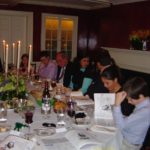
Preparing for Passover is the beginning of the spiritual journey.

I reflect on all the Jewish women making pesach in their homes as I do in my mine – cleaning, weeding out, preparing for renewal. I also think of all of the women over the past three thousand years who’ve prepared in similar ways right at this point in the calendar. Our conveniences and techniques are different, but we are connected by the desire to sanctify our homes, transforming our dining rooms into holy places.

I also recognize non-Jews who strive for the same harmony in their homes, a holiness stemming from love of family and raising children. As mothers and hostesses, keepers of an unspoken, domestic religion, we all share a generosity of spirit and sustenance.

On the morning of the Seder, with the air rich with hyacinth, I billow a crisply starched, white tablecloth over the dining room table, and honor my matrilineage. The linen napkins were passed down from my maternal grandmother, my namesake, Jeanne Wilmarth Hallenbeck, a women who passed away when I was two but who I’ve heard scores of stories about from my mother. I have a black and white photograph portrait of her framed on a small pantry counter just outside the dining room. She is holding a bouquet,  the maid of honor at her sister’s wedding. I imagine her very social era of luncheons, teas, and dinners when it was common to have several sets of placemats, dinner napkins, and luncheon napkins all with embroidered monograms. Receiving them myself as a young bride, I was afraid to use them for fear of staining. Now, they are a tactile way to remember. Like a black and white Mona Lisa, she radiates an approving smile from her photographed face.

The silver candelabras are from my mother and were wedding gifts from her grandparents. Before everyone sits, I will light their six candles before blessing the festival lights:

Baruhk ata Adonai, Eloheinu melecholam. Asher kidshanu bar mitzvah tov, vitzi vanu l”hadlik ner shel Yom Tov.

May it be Your will, God of our ancestors, that You grant my family and all Israel a good and long life. Remember us with blessings and kindness; fill our homes with your Divine Presence. Give me the opportunity to raise my children and grandchildren to be truly wise, lovers of God, people of truth, who illuminate the world with Torah, good deeds and the work of the Creator. Please hear my prayer at this time. Regard me as a worthy descendant of Sarah, Rebecca, Rachel, and Leah, our mothers, and let my candles burn and never be extinguished. Let the light of your face shine upon us. Amen.

“Regard me as a worthy descendant” – those words echo in my mind as I open my silverware drawer. For a large crowd, I need both my wedding silver, given lovingly by many older relatives, as well as my mother’s silver, which had been passed down from her grandmother. As I squeeze together enough place settings, I smile at how large our Seder has become.

I open the cabinet holding the special crystal wine goblets. They are Victorian in shape, etched with spring-like floral patterns – they are from John’s great aunts, Lillian, Bella, and Sophie, and his grandmother Rose. These women posed a funny foursome. Lillian, Bella, and Sophie were conservative Jews and very religious. They were old spinsters, living together in Philadelphia and later in Miami Beach, keeping kosher homes. By the time John and I married, Sophie was the only one of the four alive. We visited her in Miami often, and when she heard we were keeping a Jewish home and hosting Passover, she was so delighted she gave us her Seder plate, which she had purchased with her sisters on a trip to Israel.

I set the table with white, gold-rimmed dishes John’s father presented to us in honor of our new home. It seemed as if it had been crated for years. They are from Czechlosavakia had been received by his mother, Rose, as a wedding present from her groom’s family in Europe. I picture her an excited, beaming bride, receiving such an extravagant gift on her embarkation to adult life. Arthur’s eyes tear at the sight of what was once familiar. It’s like having his mother there with us. I know how he feels.

Our Seder table is a living, expanding, combination of the old and the new. There is a silver Kiddush cup I bought John in honor of our new home, and the silver pitchers I bought for the hand washing not long after. There are the colorful Afikomen covers the kids made in Sunday school. Even in their crudeness, I use them as a reminder of how far we have come, both spiritually and physically as a family.

John leads the Seder thoughtfully and deliberately, working from a new Haggadah edited by Jonothan Safran Foer, a writer I very much admire. We upgraded just last year from a more juvenile, story-book version, which had been an upgrade from the days when we photocopied one very traditional version and felt bound by its structure, and cheapened by the flimsy, tearing pages.

When I put the finishing touches on the table, the toys symbolizing the ten plagues, a wine glass for Elijah, a water glass for Miriam, salt water for dipping, I am filled with gratitude. How blessed I am to have a family and friends who want to gather and create a magical evening filled with stories and questions and debate and song. How blessed I am to have children to pass these napkins down to, these dishes, this silver.

The Passover Seder is a telling – the passing down of a story, a story of a people once enslaved and now free, a celebration of our ability to move and act in the world, a story not only of a people, but now my people. Tonight our connection to our ancestors won’t just be spoken, but demonstrated at this table, my altar is a tribute to our mothers past.

John has grown into his role as masterful leader of the Seder. He sends out questions to our guests ahead of time, a custom adopted from Nancy Meisel in Cincinnati. The question is the prompt for meaningful conversation after we’ve had our four glasses of wine, after we’ve told the story four ways and four times, and after we’ve shared the symbolic food on the Seder plate.

Every year John works hard to come up with a perfect, though-provoking question.

Questions in the past have ranged from the basic: if you were leaving Israel, what would you take (akin to if your house was burning and you had to leave in a hurry, what would you take with you?) What are your basics? What are you a slave to? Who is your Pharoah? What is your Egypt? What song exemplifies freedom to you? (That was actually a huge hit and really fun) There is always a lively family group chat in the weeks preceding – with the kids wondering what the question will be this year?

One Passover tradition is to welcome newcomers or strangers, people who don’t have another place to go. Sometimes I worry our first-time guests won’t know what they are stepping into. They may be surprised or intimidated by the question, what do they think when they receive John’s email? Our regulars are a little crazy. There is my young nephew who spews wisdom beyond his years like a prophet, the personification of Elijah himself. We sing and Charlie accompanies on the piano, there is laughter and heated debate. It starts early and goes really late and there is a lot to eat.

This year we will be hosting twenty-one. That old dining-room table / now kitchen table will serve as the extension to our dining room table. Our Seder will be on Friday, April 6, not on the traditional night, but on the Shabbat at the end of the 8-day holiday so we can get everybody home. April 6 is the Sabbath and my mother’s birthday. She would have been 75. I will light a candle for her and one for John’s mother, Mary, her yartzeit being just 5 days later. Their light will shine even more so at our table.


The Nine

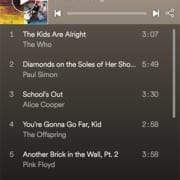
Very excited that my second novel, The Nine, will be released by She Writes Press in August 2019. Attached is a Spotify playlist to get you in the frame of mind.

How Much of This Is Autobiographical?

This is the question I receive most often when visiting with book clubs and readers. Haven’t you noticed how books or movies “based on a true story” seem to hold so much appeal? People really want to know what “really happened.” Well, I try not to disappoint.  The answer is that EDEN was inspired by events in my life and the lives of women I have known and loved. The key word being inspired, with one small exception, the characters in EDEN are not representative of any real people. (That small exception being Mary Thaw, the Pittsburgh coal fortune heiress who owned the Italianate villa on the hill and harbored residents during the 1938 hurricane.)
I recently attended a breakfast with writer Steve Almond. It was a gathering of several authors and we got onto the topic of “writing what you know.”   I asked Steve to help me reconcile that advice with what I had also been told at the Iceland Writer’s Retreat last April, that inexperienced writers are present in their work, whereas evolved writers are invisible in their writing, creating characters who  differ greatly from them as human beings. I’m still in the “write what you know” camp. I describe EDEN as a collage of experiences, a sort of cubist painting or kaleidoscope of what I’ve witnessed, all the while an exploration of themes that are best achieved in fiction.

I am in EDEN. I am that ten-year-old girl who counted out the months between her parents’ wedding date and her birth. But that doesn’t mean I’m Sarah. I invested my characters with my own emotional memory. I fictionalized and expanded on other circumstances in my family, other unplanned pregnancies to be specific, but the key word is fictionalized. If the book reads with a ring of truth, it is because I tried to capture the emotional aftermath I witnessed, while never having really known exactly how things came to be.

My second novel, The Nine, (August 2019, She Write Press) has a main character with whom I can closely relate. She is the hyper vigilant mother of a teenage boy. I can already foresee the connection readers are going to make, but I am not her!! Hannah is much more surprising than I could ever be! It is true that I was inspired to write The Nine after my family went through some traumatizing events. The process of writing helped me let go of my personal situation and see what happened as something universal: the mother-son bond (a topic that has been written about for eons), and trust, and betrayal. These are themes I want to explore while developing my plot around a compelling boarding school setting. As I wrote draft after draft and revised my work, the characters developed lives of their own. Again, their reactions and emotions are ones I have invested them with. So at the core of who these people are, there is something of me, my worldview, my heart. I am a fifty-two year old woman with a wealth of experience, and that is the well from which I source everything. So the answer is yes, of course, it is all autobiographical. I scratch my head at any writer who says otherwise.

Gratitude and Reflections for a New Year

Before I look forward to 2018’s resolutions, I need to say thank you to 2017.

There hasn’t been a year in which I’ve felt such gratification. Yes, my first novel, EDEN, was published, but that occasion became the catalyst for something much bigger. I often dubbed my book tour a friendship tour because it became an excuse to connect with old friends and make many new ones. Coming out from under my rock of solitary writing, I re-connected with people. I have never felt so supported, not just by friends and family, but by a higher source of creative energy. Whereas my schedule had always felt overbooked and conflicted in the past, author events fell into place almost magically and people appeared along the path at steady intervals to open doors. Approaching each day with an attitude of “yes”, I surfed a wave of generosity, and it was a life-changer.

In 2017, I was the beneficiary of so much kindness, from authors who blurbed my novel to readers who hosted book parties and book club events, to relatives who went out of their way to be supportive. These gestures have permanently changed me. I have always considered myself a “giver”, but from now on I will always say yes when it comes to supporting a friend or another artist, a friend’s favorite cause, or a person trying something new. There is an abundance of love in the world and I am excited to add to it.

Now for doing it better in 2018…..

Even writers with established practices have to make a conscious decision to show up every day. I’ve played around with which structure works best for me and I seem to have the most energy in the morning. But I’ve recently added something new from the “The Artists Way: A Spiritual Path to Higher Creativity” by Julia Cameron, writing long hand morning pages followed by an affirmation before diving into novel revisions.

Morning Pages are intended to serve as a place for unloading the clutter that’s often at the forefront of one’s mind. Whether a writer is aware of it or not, clutter often prevents creativity energy and great ideas from revealing themselves. I typically meditate in the morning with the hopes of accomplishing the same “cleanse”, but for the next month I am going to experiment with both meditation and morning pages. I will need to rise a little earlier in the New Year in order to find time for my ever-lengthening morning routine!

And that leads me to the most important resolution of all! Going to bed earlier….. I am such a disciplined person, but staying up late is a big weakness. Getting up an hour earlier every day could lead to so much….. Here we go!

Thinking about Adam, Eve, and the Garden

As I’ve traveled from place to place over the past seven months talking about EDEN, it has been revelatory that many readers do not connect my novel with the metaphor of the Garden of Eden. I would have thought the book’s title would be the first giveaway. This is less a commentary about people’s comfort with biblical references, than a testament to the fact that Eden has become a common term in our society’s vernacular. It stands on its own, independent from the Bible as a synonym for paradise.

In late October, I attended the Boston Book Festival as both a presenter and an interested member of the audience. My husband and I attended a fascinating discussion with Stephen Greenblatt, author of the recent book The Rise and Fall of Adam and Eve. In his wonderful and scholarly book, Greenblatt examines the story through history’s eyes: from the point of view of scholars, and artists, and poets and questions what it is about the story of the Garden of Eden that proves it to be “so durable, so widespread, and so insistently, [and] hauntingly real.” From examinations of Durer’s art to Milton’s most famous work, it is a sensational book, which I recommend highly.

The story of Adam and Eve certainly shaped society’s concept of marriage: A man shall leave his father and mother and shall cleave unto his wife: and they shall be one flesh…. an ideal concept at that. The story goes on to provide imagery for what is good and what is evil. It gives us the first documentation of  sin. It provides fodder for the characterization of women as manipulative and conniving, and for men as laborers and providers. I would challenge someone to come up with a story that is as impactful as this one on how society defines our most fundamental relationships.

Its structure is ingrained in us, an archetype. There is a man and a woman. They are placed in a paradise. There is temptation. They want more. There is a decline and an expulsion. They go on.

I recently read Crossing to Safety by Wallace Stegner, one of those books that is referred to time and again by writing teachers, while Greenblatt sat on my bedside table, and grinned at the reference to Sid and Charity’s Vermont utopia as ‘Eden’ – and of course this ‘Eden’ doesn’t last. The grand home in my novel is also named “Eden,” but in a tongue-in-cheek manner meant to foreshadow pitfalls on the horizon. I can’t help shaking my head when coming across locales dubbed “Eden” – Bar Harbour, Maine was originally named Eden, for example. Many people seem to want to memorialize paradise, possibly forgetting the second half of the story.

Instead of place, I like to think of Eden as the state of innocence one experiences in childhood; an innocence that inevitably disappears once the complications of adolescence and adulthood take hold. The Adam and Eve creation story is compelling for all it evokes around the relationships between man and woman, but its early setting, that moment of perfection is what strikes me. It is a moment with a special place in the recesses of our collective memory.