The Price of a College Admission Scandal
I had to pull my jaw off the floor reading the recent reports of parents and college admissions consultants gaming the system. Even though the college admissions process has never been ‘fair,’ the hacks these people created stooped to a whole new level. I should qualify this post with the fact that as a fourth generation applicant to Smith College, I was a beneficiary of the uneven playing field myself. Even though I was admitted to equally fine institutions, I attended Smith as a legacy. What’s more, all three of my children were recruited athletes to Ivy League institutions, competing in squash, and leading and captaining their respective college teams. Although they were qualified candidates, the ability to bypass the general application pool was an enormous boon. These schools admit about 220 recruited athletes per year across all sports whereas the general application pool is flooded with upwards of 30,000 people. Tough odds for even the best of the best.
As in life, systemic privilege has always existed with college admissions, although typically more subtly, reserved for those in the know, those tipped off early as to how the game works. (I’ll go ahead and throw myself in that group.) The parents who worked with “The Key,” however, were made aware of a “side door,” and did whatever it took to gain entrance at the eleventh hour. It was like a big, bad case of cutting in the carpool line. The transcripts included in the indictment depict parents who had no problem with the six-digit price tag for an admissible test score, on the condition their children were none the wiser, as if betraying a child’s trust was fine as long as it went undiscovered. One father even laughed at his child innocently assuming he’d achieved a good ACT score on his own.
In my forthcoming novel, The Nine, Hannah Webber is a middle class mother who prescribes to the slow and steady approach (much like mine): nightly dinners, homework sessions, attendance at sports practice, healthy breakfasts, school pick-ups and drop-offs or at least a best effort. There is mundanity to the routine, a year-in-year-out scheduling of parent-teacher conferences, supporting kids through ups and downs, but always emphasizing hard work and doing one’s best above all else. Consistency. Trust. Listening. It isn’t always easy. And again, probably speaks to the privilege of a childhood where a parent is at home to provide the steady support. But just like many parents today, Hannah Webber will realize even her best efforts aren’t enough when pitted against parents with money.
Privilege is pervasive in reality as well as fiction, but the recent revelation of cheating has provided our culture with a moment – not only to gawk at the defendants’ insane behavior, but to evaluate the status quo and the spectrum of admissions abuses: how donations to schools are treated, why athletics and athletes should matter so much, how unlimited test taking time and bogus doctor diagnoses has become a thing. It’s an important conversation, but I hope the point that hits home the hardest for parents (including Hannah Webber) is that integrity, honesty, and a relationship with their children built on trust will always be worth more than any diploma!!




 The following article was originally published on
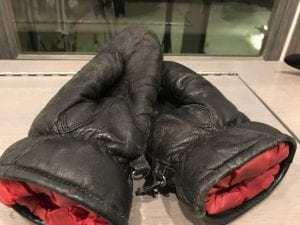 My mother’s mittens are soft and worn, of black leather and insulated with red nylon and down fill. I wore these fifty-year-old mittens every day this past March and wondered what she would have thought of my extravagances: an EPIC pass in my pocket and accommodations just a short walk to the mountain. She was a frugal Yankee who insisted we be first on the lift and not stop until at least 3:30 pm to get our money’s worth. I’d never even set foot in a lodge before spending a ski weekend with a friend’s family because my mom laced up (yes I’m dating us) in the parking lot to save precious time and she carried our lunch in her pockets.

 I scoffed at the parents, briefcases in hand, dressed smartly, waving furiously and tearing up at the “Goodbye Window.” I donned an ensemble of sweats, maybe even the t-shirt I’d slept in, and a hat and down jacket long enough to cover the entire mess. My eldest son was three and a half and I’d drop him each morning in the ‘green room,’ his younger siblings in tow. Sometimes literally drop him.
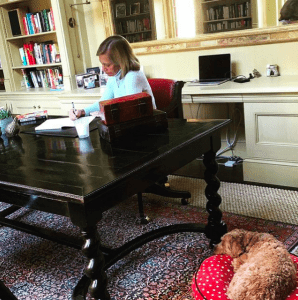 I took a “Writing from Personal Experience” class in Cambridge taught by Mopsy Strange Kennedy. An exercise she often assigned us involved going on “writerly walks.” She encouraged us to travel our usual paths but make the effort to really notice – maybe for the first time – the details along the route: the bicycle chained to a post, the balustrade in need of paint, the torn screen on a window. After the walk, we were supposed to write about a particular object, the more mundane the better, but the purpose was to infuse that object with meaning. It was a good way to develop writing muscle as well as the art of paying attention. I noticed quirks and color and inconsistencies. I noticed the way the sun reflects off a window or the way steam rises off hot pavement, windows that were open wide and music that traveled to the sidewalk, even the scent of hot pizza escaping a delivery bike’s insulated red container. I noticed trash and dog poop, as well as crocuses pushing up through the earth.


 Our boat was loaded down with golf clubs, hostess gifts, costumes for a Saturday night party, bedding, clothing, and cheese and crackers. The dog was at the sitter’s and the sun was high in the sky. Our plan was to stop first at the gas dock in Avondale before starting our journey north along the Rhode Island coast, through Buzzards Bay to Marion, MA. We wanted to arrive in time for dinner.